7/21/2018

Interesting new Gallup Survey: No one views Global Warming as most important problem and only 2% view gun control that way

A copy of the Gallup survey is available here.

Also of interest is the percent of Americans who are satisfied with the direction of the country. The percent of Americans satisfied with how things are going in July of election years isn't a great predictor of how people will feel that November, but 35 percent who were satisfied this July was 7 percentage points higher than the previous high in July 2012.

July 2010: 21 percent satisfied
November 2010: 19 percent satisfied
July 2012: 28 percent satisfied
November 2012: 31 percent satisfied
July 2014: 24 percent satisfied
November 2014: 20 percent satisfied
July 2016: 17 percent satisfied
November 2016: 37 percent satisfied
July 2018: 35 percent satisfied

Labels: ,

12/23/2015

More Americans view letting more people carrying concealed handguns as a better solution to terrorism than stricter gun control

There has been a sharp rise in concern over terrorism, with few Americans believing that the government can stop lone-wolf attacks (22-77 percent) and not many more can stop a large scale attack (43-56 percent).  A new Gallup poll shows that terrorism has become the number one issue on voters' minds (16% rank terrorism as the number one issue, 13% say government, and 9% say the economy).
President Obama keeps pushing for more gun control as the solution to the threat of terrorism.
We know that the killers in San Bernardino used military-style assault weapons—weapons of war—to kill as many people as they could.  It’s another tragic reminder that here in America it’s way too easy for dangerous people to get their hands on a gun.
For example, right now, people on the No-Fly list can walk into a store and buy a gun.  That is insane.  If you’re too dangerous to board a plane, you’re too dangerous, by definition, to buy a gun.  And so I’m calling on Congress to close this loophole, now.  We may not be able to prevent every tragedy, but—at a bare minimum—we shouldn’t be making it so easy for potential terrorists or criminals to get their hands on a gun that they could use against Americans. . . .
A new ABC News/Washington Post Poll puts asks people whether the best way to respond to terrorism is stricter gun control or letting people carry permitted concealed handguns for protection.  A majority of Republicans and Independents, moderates and conservatives, as well as those in the broad middle class view permitted concealed handguns as the preferred solution (see below).
Screen Shot 2015-12-19 at Saturday, December 19, 6.11 AM 1
ABCWashPostPoll_ViewsByDemographic_1216
A recent CNN poll from October had a smaller difference of only 2 percentage points, but it mentions neither the words "concealed" nor "legal."
Screen Shot 2015-12-19 at Saturday, December 19, 6.11 AM
UPDATE: Hillary Clinton was asked about this ABC News/Washington Post survey during the December 19, 2015 Democratic Presidential Debate.

MARTHA RADDATZ: Secretary Clinton, in the wake of the San Bernardino attack, you all emphasized gun control. But our latest poll shows that more Americans believe arming people, not stricter gun laws, is the best defense against terrorism. Are they wrong?
CLINTON: "Well, I think you have to look at both the terrorism challenge that we face abroad and certainly at home and the role that guns play in delivering the violence that stalks us. Clearly, we have to have a very specific set of actions to take. When senator Sanders talks about a coalition, I agree with him about that. We've got to build a coalition abroad. We also have to build a coalition at home. Abroad we need a coalition that is going to take on ISIS. I know how hard that is. I know it isn't something you just hope people will do --"
RADDATZ: Secretary Clinton, can we stick to gun control?"
CLINTON: "I'm getting to that. Because I think if you only think about the coalition abroad you're missing the main point, which is we need a coalition here at home. Guns in and of themselves in my opinion will not make Americans safer. We lose 33,000 people a year already to gun violence. Arming more people to do what I think is not the appropriate response to terrorism. I think what is
Labels:

11/11/2015

Gun Control is the Strongest Election Issue for Republicans over Democrats and that is the one topic that they have been getting even stronger on

PEW Survey on Election Issues
The new PEW Research Center Poll shows that gun control is the strongest issue that Republicans have over Democrats, and that gap has been growing.  And while Democrats have been getting stronger against Republicans on abortion, foreign policy, taxes and terrorism, the one issue that Republicans have been getting stronger compared to Democrats is gun control.
PEW Survey on Election Issues Changes over time

Labels:

5/31/2014

"Wide support for 'gun violence restraining orders'"

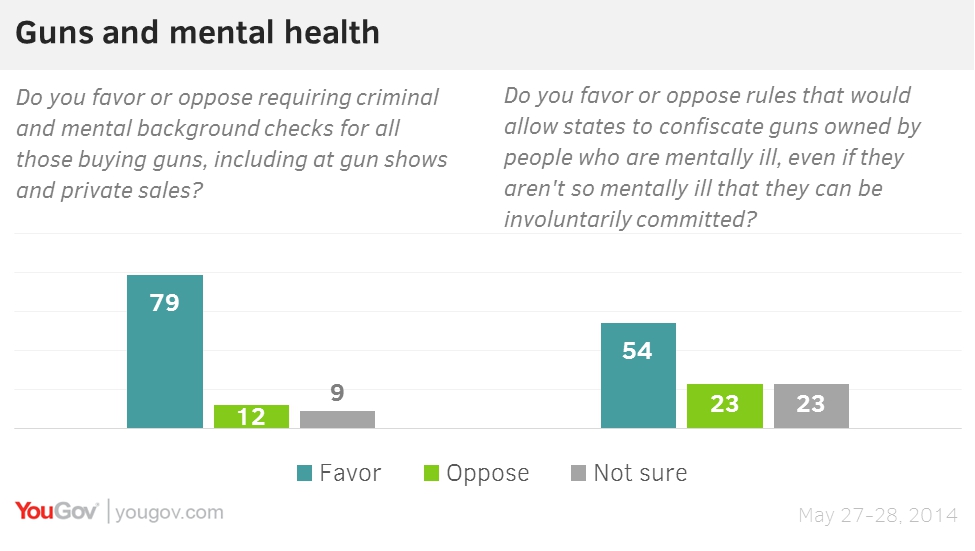
First, let me say that it isn't obvious how accurate this poll is for one simple reason: it was done right after a tragic attack (of course, the poll doesn't mention that half the victims were stabbed to death or that most of the injuries were due to the car that the killer was driving).  When you do a poll right after an attack it shows you about the worst numbers that you can show on the gun control front.  YouGov has a poll showing strong support for taking away people's guns if they have "mental illness."  California is considering taking away people's guns "if they are mentally troubled and their behaviour is reported to the authorities by friends of family."  Given current judicial precedent,  I have a hard time believing that someone's guns can be without a judicial hearing.  The incentives that this rule would create to harass people that relatives aren't happy with could create all sorts of bad consequences.

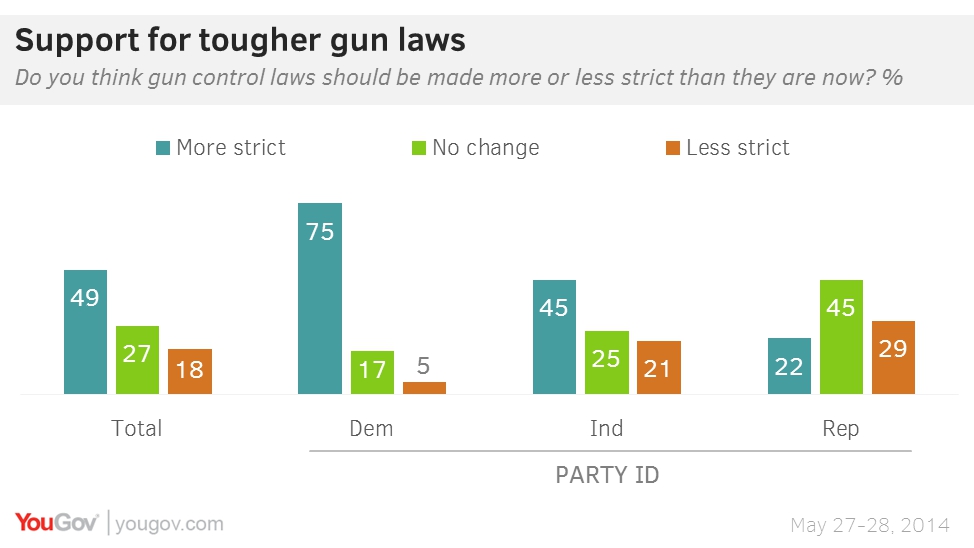
Regarding overall gun control, 49 percent want more gun control and 45 percent want things to either stay the same or be loosened.  If this is the worst that these numbers are right now, there is still a general trend against more gun control.

Labels:

5/05/2014

The calm before the storm: polls moving in the right direction on guns, but the battle is about to get fierce

From Danny Franklin in the Washington Post has this piece of good news:
In 2000, an ABC News/Washington Post poll found that 51 percent of those surveyed believed having a gun in the house made it a more dangerous place to be, while only 35 percent believed it made a house safer. In a poll of 800 voters I conducted recently, opinions were almost perfectly reversed: Fifty-three percent now believe a gun makes a house safer and 35 percent more dangerous. . . .
He also argues:
The problem is that supporters of new gun restrictions have traditionally approached the issue of gun violence as a political problem to be answered by changing laws. Instead, we need to start looking at guns as a public health problem to be answered by changing minds and habits. . . .
I interpret this as confirming what I already knew: gun control advocates are planning a big push to control the facts used in the gun control debate.  With literally hundreds of millions of dollars coming from the likes of Bloomberg, Soros, the Obama administration, and others, this battle is far from over.

Labels: , ,

3/30/2014

Do people feel safer if they own guns in the home?

An analysis of polling data of whether people feel safer owning guns in their homes is available here.

Labels:

2/09/2014

By 2-to-1 margin Americans believe in More Guns, Less Crime

This is from a Fox News poll given from January 15-17, 2013, and it was done right after the Newtown attack.  Presumably the results at other times would have been even more lopsided.

Labels: ,

2/02/2014

The big increase in support for concealed handgun laws

Patrik Jonsson makes this point in today's Christian Science Monitor:
The view of gun carriers as law-abiding citizens seems to have traction and correlates with increasingly positive public attitudes toward concealed carry. In 1999, an NBC News/Wall Street Journal poll found that 73 percent of Americans disapproved of making it easier for people to legally carry concealed weapons. In a Reuters/Ipsos poll last spring, 75 percent favored concealed carry by eligible citizens. . . .
The article also has involved an interview with me.
Arguments for concealed carry 
"I don't argue that there are no problems with [concealed-carry permit holders], but when you look at the data it's pretty hard to find any other group in the population that's as law-abiding as" permitted gun carriers, says John Lott Jr., an economist and gun-rights advocate and author of "More Guns, Less Crime." 
"The type of person who's going to go through the process of getting a concealed-carry permit is not the kind of person you have to worry about," he says. "They're law-abiding citizens who have a lot to lose if they make a mistake." 
Statistics support Mr. Lott's assertion. The number of incidents in which concealed-gun carriers kill innocent people is a fraction of 1 percent of all gun-related homicides. In North Carolina, one of only a handful of states that reveals the identities of permit holders, 200 of the 240,000 concealed carriers (.08 percent) committed felonies of all types, including eight shooting deaths, in the five-year period ending in 2011. This compares with about 2.5 percent of voting-age Americans who have a felony rap sheet, according to The Sentencing Project. . . . 

Labels: ,

1/31/2014

So much for the claim that Americans want stricter gun control, 56% of Americans are against making gun laws stricter

The headline for Gallup was that "Americans' Dissatisfaction With Gun Laws Highest Since 2001."  While dissatisfaction is up, what is interesting to note is that most of the increase is from people who want the laws less strict.  Since 2012 the percent who want less strict laws has increased from 8 to 16 percent.  The percent who wanted looser gun laws actually tripled over the last year.


It is also interesting how consistent the opposition to new gun laws has been over the last decade.  Those who were happy with the current law or wanted it looser totaled 56 percent in 2002, 2003, and 2007.  In 2004, 2005, and 2008, the total was 57 percent.

So much for the claim that Americans what stricter gun control.  See here for related discussions.

Labels:

1/23/2014

So if Democrats know what they are doing on gun control, why is it that so few people approve of his job on that issue?


A new Fox News poll shows that the approval/disapproval gap is bigger for Obama on gun control than it is on all but one other issue. 22 percentage points more people disapprove of Obama on gun control than approve of the job that he is doing.  But heck, that is only one percentage point worse than it is for the job that he is doing on the economy, and we all know how well that is going.


Even back in April when Obama was pushing hard for the Senate vote on gun control, his approval rating on this issue was only 39%.

(Note: I think that for Iran it is 35% approve/53% disapprove.)

Labels:

1/11/2014

So why don't pollsters regularly ask which political party is closer to voters' views on guns?

I have often wondered why pollster don't regularly ask this question: Which party is closer to you on gun control?  It turns out that The Economist/YouGov poll did ask this question for a while during 2010.  Does the double digit lead that Republicans have over Democrats on this issue explain why gun control isn't included when pollsters ask about everything else from the economy to health care to foreign policy.  Here are the results that I found for 2010.


The Economist/YouGov polls from other points in time is available here.

Labels:

12/27/2013

By 2-to-1 margin Americans don't think that tighter gun control laws will prevent criminals from getting guns, 4% more Americans think armed school officials better than more gun control in stopping school shootings

A new survey from Reason-Rupe that was conducted December 4–8, 2013:

Labels: , ,

12/07/2013

Gallup's mysteriously missing 4.8 million gun owners

In October, 2011, Gallup reported: "Forty-seven percent of American adults currently report that they have a gun in their home or elsewhere on their property. This is up from 41% a year ago and is the highest Gallup has recorded since 1993, albeit marginally above the 44% and 45% highs seen during that period."  The Gallup data on gun ownership since 1991 was provided in this graph from Gallup.


OK, but here is the big puzzle.  Gallup has apparently redone its survey data on gun ownership rates, shifting down gun ownership rates.  The shift hasn't just occurred in recent years, but goes all the way back to at least 1991 and the drop seems to be by two percentage points in each survey.  This data shows that gun ownership is about the same as it was in 1983 and 1996.


The old numbers showed 47 percent owning guns in 2011.  Now the new numbers is supposedly 45 percent.  For 2010, it used to be 41 percent.  Now it is 39 percent.  The 2009 number used to be 42 percent.  Now it is 40 percent.  This goes all the way back.  The 1991 number used to be 50 percent.  Now it is claimed to be 48 percent.  The dates match up exactly and the survey questions are the same, so it isn't just that these results are from different surveys.


This rewriting of past survey data is not trivial.  In 2011, that change implies 4.8 million fewer adult gun owners (the census information is from here).  

The puzzle gets even more bizarre when one looks at other survey data.  If there was a re-weighting that Gallup thought was more appropriate, it should have impacted other surveys that they did.  Yet that isn't the case.  Given that the October 2011 and earlier gun survey data was changed, I decided to look at the approval rating data for the 2011.  

For example, here are the survey data on whether people are generally satisfied with the total cost of healthcare in the US.  The most recently reported data is available here.


Here is a survey discussion of the same data from 2009.  This line is exactly the same as the lower line shown above.


As another example, take the weekly survey data for the presidential approval rates from January to November 2011.  It is identical whether one looks at the recent reports of that time period or the data as it was reported in 2011.

The most recently reported data is shown here.


The original data is shown here.

Here is a screen shot of the 2011 Gallup report on changes in gun ownership over time.


Labels: ,

Americans opposing more gun control: New Gallup Poll shows exact same breakdown as CNN poll about those who favor or oppose stricter gun control


Click on figure to make it larger.

The latest Gallup and CNN polls both show the exact same favor and opposition to more gun control (50% oppose / 49% favor).  The CNN polls shows a record level of opposition to more gun control.  The Gallup poll numbers aren't a record high, but they do show a general trend towards opposition and that all the poll values of 50 percent or more opposing more gun control occurring since 2009.

The question is if Americans are evenly divided on having new gun control, how accurate can it be when gun control proponents claim that people want more gun control?

The Gallup numbers are as follows.


Labels: ,

12/06/2013

CNN Poll: Most people ever recorded opposing more gun control


Click on figure to make it larger.

You might think that support for stricter gun control would be relatively high these days.  After all, gun control groups and Democrats frequently claim that is the case.  Bloomberg's millions might also be making a difference.

But that is not the case.  From CNN, 50% of Americans oppose stricter gun control.  The previous high opposition was 47% in February 1996.  The average opposition was 38%, so the current opposition is 12% higher than the average.

The question is if Americans are evenly divided on having new gun control, how accurate can it be when gun control proponents claim that people want more gun control?

Labels: ,

9/08/2013

Pew Poll on support for Gun Control

The Pew Poll is available here.

Labels: , ,

4/27/2013

Remember those claims that 90% of Americans wanted the Senate background check bill to pass?: Well, it was clearly wrong


Despite assurances by the likes of Nate Silver that these are solid polls showing "Overwhelming majorities of 80 to 90 percent of the public say they favor background checks," I have previously noted my skepticism of these claims.  To me, it wasn't too surprising that the Senate voted down the gun control bill about 10 days ago.  My concern is that people were really just being asked about whether they wanted to keep criminals from getting guns, not about the particular legislation being voted on by the Senate.  Well, now there is another poll by the PEW Research Center that I think is much more accurate.  It asks people whether they are happy that the Senate gun control bill was stopped.  Apparently, both Republicans and Independents are generally happy that it was stopped.  My guess is that Republicans should pay a lot more attention to what Independents and Republicans wanted than Democrats who would never have voted for the Republicans anyway.  It looks to me that Republicans voted the way that their constituents wanted.  So Republicans shouldn't really care that among all voters the poll showed support of 47 to 39 percent.  They should look at the results by political affiliation.


Many, such as the New York Times, paint a picture of Senators who both simultaneously opposed the will of 90 percent of their voters and at the same time quake in fear of the NRA. Here is a piece by Joe Nocera at the New York Times on April 19th:

The four Democrats — along with many Republicans — quake in fear of the National Rifle Association. In 1994, Baucus voted in favor of the assault rifle ban — and then nearly lost his re-election bid. He never again stood up to the N.R.A. Yes, his phones were undoubtedly jammed this week. Still, it seemed to me that his unanswered phone was a potent symbol. I could almost picture him cowering in his office, waiting for us to stop asking why he sold the country down the river. . . .
Note in Baucus' case, he is retiring and yet he still voted against the so-called "universal background check" bill.  Might Mr. Nocera re-examine his piece?

The one US Senator who gun control advocates claim has been hurt by her opposition to the Senate gun control bill is Kelly Ayotte (see also here, though one will note that six months and a lot of other things have occurred since the last approval rating poll for Senator Ayotte).  Yet, it is interesting that the Democratic controlled state House of Representatives in New Hampshire isn't passing new gun control either.  From the New Hampshire Union Leader:

"NH State House Unmoved by Newtown Shootings" was the headline of a Patch.com story about a recent gathering of "area gun violence experts," hosted by the Portsmouth Democratic Party (of course) and including a representative of States United to Prevent Gun Violence, at the Portsmouth Public Library. 
A more accurate headline would have read, "Portsmouth Gun Control Panel Unmoved by Reality." 
According to the story, the "gun lobby" is so strong in New Hampshire that it will be next to impossible for anti-gun politicians to pass "universal background checks," allegedly making massacres like the Newtown tragedy more likely in this state. . . .
A collection of polls on gun issues is available here.

Other tangentially related material

By the way, the Nate Silver analysis of how Senators would vote on the Manchin-Toomey bill has some major problems, he uses a very unreliable measure of gun ownership from Behavioral Risk Factor Surveillance System (it shows among the lowest gun ownership rates of any survey that I know of).  If you use a bad survey, you get a lot of noise and it makes it more likely that you won't get a statistically significant result.  I also like the way he runs a regression after the fact rather than predicting how people were going to vote before the Senate vote.  Letting him play around with different factors (we have no idea how many regressions that he ran before he decided to report the one that he did) makes the predictive power of that regression pretty useless.

UPDATE: Democratic polling firm Public Policy Polling (PPP) claims to find drop in support for five Senators, but for some of these polls the time since the last poll has been over six months, though a couple of others have just been since February.   


UPDATE: Obama's approval rating on guns has also fallen.  As one headline put it, "Obama's Approval Rating on Gun Control Plummets."  Here is part of the June 4th article:
Nearly half of voters think President Obama's doing a poor job at handling gun control, according to a Rasmussen Reports poll released Tuesday. Only 37 percent of voters give Obama positive reviews for the way he's handling gun control as opposed to the 46 percent of voters who give him a poor rating.  
The president's poor approval numbers have been climbing over the past few months. They were 34 percent in February and have climbed 13 points since then. . . .

Labels: , ,

4/26/2012

Increasing support for gun ownership

Source: Pew Research Center.
Currently, 49% of Americans say it is more important to protect the rights of Americans to own guns, while 45% say it is more important to control gun ownership. Opinion has been divided since early 2009, shortly after Barack Obama’s election. From 1993 through 2008, majorities had said it was more important to control gun ownership than to protect gun rights. . . .

Labels: , , ,