A very thorough review of my book Freedomnomics
Labels: Freedomnomics

Welcome! Follow me on twitter at @johnrlottjr or at https://crimeresearch.org. Please e-mail questions to johnrlott@crimeresearch.org.
Labels: Freedomnomics

Labels: Freedomnomics
Myine Electronics' Abbee radio strips out ads and DJ chatter
By Edward C. Baig, USA TODAY
You adore listening to tunes on the radio. You just don't adore the lame commercials and blathering DJ chatter that accompanies the music. The $250 Abbee Commercial-Free Music System that I've been testing aims to solve this age-old predicament. The product, from Michigan start-up Myine Electronics, consists of two main components: a tabletop base stereo speaker system with a built-in FM tuner and a portable player called Music Lock, which plugs into the base. The twist: Abbee can automatically record songs from whichever FM station you're tuned to — but it manages to do so without the ads and idle chitchat. . . .
For the most part, Abbee works as promised. On only one song —The Young Rascals' Good Lovin' — did I hear a DJ who yammered well into the start of the selection. On a couple of other tracks, I heard a single word (e.g., "Supremes") from a DJ. The music sounded fine at the digital audio broadcast quality of 192 kilobits per second, though there were slight variations in volume on some tunes. I listened through the supplied earbuds and my car stereo (an auxiliary cable is included).
Still, there are drawbacks. On some songs, eliminating the DJ also means clipping the beginning or end of a track, just enough in a few instances to be bothersome. . . .
Labels: Economics, Freedomnomics

Labels: Freedomnomics
Labels: AnnCoulter, DennisMiller, Freedomnomics
Labels: BookReviews, Freedomnomics
Labels: Freedomnomics
By taking a couple of courses in economic theory, we could immunize ourselves from nonsense spouted by politicians and pundits, but in the meantime check out Professor John R. Lott's "Freedomnomics: Why the Free Market Works."
His first chapter is "Are You Being Ripped Off?" It addresses myths about predation where it's sometimes alleged that corporations will charge below-cost prices to bankrupt their rivals and then charge unconscionable prices. There's little or no evidence that corporations would choose predation as strategy; there are too many pitfalls. A major one is that in order to recoup losses from charging low prices to bankrupt rivals, the predator would later have to charge higher-than-normal prices. That would attract new rivals who might have purchased the bankrupt assets of the predator's prey and be able to undercut the predator's prices. . . .
Labels: BookReviews, Economics, Freedomnomics
What restrains politicians and businesses from acting dishonestly? A lot of people would answer: nothing.
Periodic political and corporate scandals have created a popular image of politicians and businessmen as little more than a collection of cheats, liars and crooks. However, while there will always be some dishonest people in any profession, the vast majority of American politicians and businessmen do not end up being frog marched out of their offices in handcuffs with their heads held low in shame before a gaggle of news cameras.
What helps keep companies honest is the threat that if they cheat customers, people won’t buy from them again. But that won’t work for politicians. Politicians don’t always have the incentive of re-election because eventually they all face a last term in office. Politicians retire at some point. They can’t live forever.
So, if it isn't the threat of facing the voters, what could ensure that politicians keep their promises?
There has been a lot academic work studying this question, and the way to solve the problem is to elect politicians who inherently value the policy positions that they take. . . . .
Labels: Economics, Freedomnomics
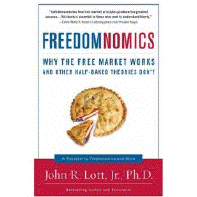
John Lott, an economist and author, will sign copies of his new book "Freedomnomics: Why The Free Market Works and Other Half-Baked Theories Don't" at a Tuesday book signing sponsored by the Maryland Republican Party.
Dr. Lott is an economics professor at the University of Maryland and has held posts at the University of Chicago and Yale University, and has served as chief economist of the United States Sentencing Commission that establishes sentencing policies and practices for the federal courts.
He has written five books, including one supporting gun rights.
The book signing will be held from 6-8 p.m. at the Maryland Republican Party Headquarters, 15 West St. in Annapolis. . . .
Labels: Freedomnomics
Is 2008 the last hurrah for public-that is, taxpayer-financing of presidential campaigns? Since 1976, taxpayers have shelled out about $3 billion in current dollars to pay for presidential campaigns, including campaigns by John Hagelin, Lyndon LaRouche, Lenora Fulani, Ralph Nader, Sen. Alan Cranston, Milton Schaap, Ruben Askew, and other also rans. Funds have also paid for balloon drops at the party's conventions, negative TV ads, robocalls and more.
But this year, most leading presidential contenders refused to take the public subsidy-and accompanying spending limits-during the primaries. One exception has been Sen. John McCain. But faced with certain campaign realities, he too is now looking for a way out and is arguing that he has a constitutional right to withdraw from the public funding system for the primaries and, instead, rely on private money. Sen. Barack Obama said last year that he would accept taxpayer financing in the general election if the Republican nominee did too, but he has backed away from that promise.
All this is happening despite the fact that Republicans are nominating their champion of campaign finance reform, Mr. McCain, and a year ago Mr. Obama was lauded in the headlines and media coverage for his dedication to saving public financing of presidential campaigns. . . .
Labels: Economics, Freedomnomics
Prices for goods such as blades for razors, ink for printers and concessions at movies are often set well above cost. This paper empirically analyzes concession sales data from a chain of Spanish theaters to demonstrate that high prices on concessions reflect a profitable price discrimination strategy often referred to as metering price discrimination. Concessions are found to be purchased in greater amounts by customers that place greater value on attending the theater. In other words, the intensity of demand for admission is metered by concession sales. This implies that while some consumers' surplus may be reduced by the high concession prices, surplus of other consumers on the margin of attending may increase from theaters' decisions to shift their margins away from movies and toward concessions.
Labels: Economics, Freedomnomics
However, I read Freedomnomics by Economist Dr. John Lott. This book was a pretty easy read and I found some of the information jaw dropping. His specialty is crime and punishment and Chapter 4, which focuses on that, just blew me away. It really showed how conventional wisdom is flat out wrong when you look at the data on crime. . . .
Labels: Freedomnomics
I read it because I read Freakonomics, which, like other political (and semi-political) books, I found to be about "half-right," which is to say that a critical reading reduces it to the level of fiction; Freakonomics is opinion mixed in with statistics.
Freedomnomics proved to be exactly what I expected, which is to say, exactly the same but with different opinions. Where Freakonomics contests that Abortion decreased crime, Freedomnomics contests the opposite. Where Freakonomics says you shouldn't trust your Real Estate agent, Freedomnomics suggests otherwise.
I enjoy reading these kinds of books because I do read them through a critical lens, and I enjoy the facts that come out of them. Usually, a critical reading of these books allows the reader to examine the statistics and draw his own conclusions, often completely different than the opinions presented by the author(s).
For example, I learned from Freedomnomics that the "lemon effect" on new automobiles presented in Freakonomics is not true. This makes sense - the idea had long since made very little sense to me, as cars usually have warrantees that transfer with ownership transfers. Though Freedomnomics presented some opinions that seemed unfounded, the facts concerning automobiles (in the form of Kelly Blue Book prices) were also present, and these are indisputable . . .
Labels: Freedomnomics
WASHINGTON (Reuters) - The Supreme Court said on Friday it would decide whether the death penalty can be imposed for the crime of raping a child, expanding its review of how capital punishment is carried out in the United States.
The nation's highest court agreed to hear an appeal by a Louisiana man who is the only person in the United States on death row for a crime other than murder. He is arguing the death penalty for child rape violates the constitutional ban on cruel and unusual punishment. . . .
Labels: DeathPenalty, Economics, Freedomnomics, SupremeCourt
The short version: my doubts are small. Read it, read it, read it, and, oh yeah, read it.
Labels: Freedomnomics
The Czech healthcare system undergoes a minor revolution on 1 January as patients are asked to pay a small fee each time they visit their doctor.
The move is part of a widespread reform of the health sector unveiled by the centre-right government.
It is far from popular - a number of leading figures are calling on Czechs not to pay up.
Czechs enjoyed free healthcare during four decades of communist rule and in the past 17 years of capitalism.
But from 1 January, Czech patients will be asked to pay 30 crowns (£0.83; 1.1 euros) for each visit to the doctor, and 60 crowns for each day spent in hospital. . . . .
Labels: Economics, Freedomnomics, Health, healthcare
I first heard of Dr. John R. Lott's Freedomnomics: Why the Free Market Works and Other Half-Baked Theories Don't on Neal Boortz's radio program. Mr. Boortz made repeated reference to one particular chapter in the book dealing with the effects women's suffrage has had on the growth of government in the United States, and I found my interest piqued, especially as our household already has Dr. Lott's More Guns, Less Crime on our shelves, and I know him to be a meticulous researcher. . . .
As I said, Dr. Lott covers far more than this. Overall, the book is to-the-point, logically organized, quite accessible to the layman, and highly entertaining. Highly recommended.
Labels: Freedomnomics
A great book about incentives, progress and human behavior is Freedomnomics, a well written rebuttal of the book Freakonomics. To get “the other side of the story”, check it out.
Labels: Freedomnomics