4/06/2018

So why is the US Trade Deficit going up?

From CNBC:
The U.S. trade deficit increased to a near 9½-year high in February as both exports and imports rose to record highs . . . . 
The Commerce Department said on Thursday the trade gap rose 1.6 percent to $57.6 billion. That was the highest level since October 2008 and followed a slightly downwardly revised $56.7 billion shortfall in January. . . .
The recent tax cuts that have made the US a much more attractive place to invest, causing us to run more of a surplus in the capital account (the account that looks at trading of assets between countries).  As the US becomes a more attractive place to invest, more money is invested in the US relative to other countries.  But that means, if the exchange rate is to remain constant, they will have to run a deficit in the combined goods and services accounts. 


Labels:

2/01/2018

How stocks prices around the world soared after Trump's election on November 8, 2016

People know how US stock prices soared immediately after President Trump was elected.  That is easy to explain because of the prospects of lower taxes and regulatory reform.  But more amazing is how stock prices around the world increased at the same time.  So many think that economics is a zero-sum game.  That was is good for the US is bad for the rest of the world.  And, surely, lower taxes in the US will increase investment in the US at the expense of what happens in other countries.  But fewer regulations and lower taxes in the US have apparently meant a more productive world economy. 

Click on figure to enlarge it.


Labels: , ,

8/01/2014

Have you ever wondered why Rotisserie chickens are so cheap? They actually cost less than a chicken that you could buy to fix yourself

Megan McArdle deserves a hat tip for pointing to this article by Cat Vasko:
A couple of years ago, I got it into my head that I wanted to roast a whole chicken, just because. I wandered around my local Ralphs for a few minutes looking for poultry that hadn't already been turned into individually shrink-wrapped meat units before asking for help. The gentleman I flagged down blinked a few times at my question. "Um," he answered finally. "You know we have chickens for sale up at the front of the store that have already been cooked, right?" 
I bought the raw chicken anyway. I took it home, rubbed it in butter and herbs, shoved a lemon half up its butt, and roasted it low and slow for the majority of the day. It turned out okay. For all the work it took, it certainly wasn't notably better than a store-bought rotisserie chicken, and with the other ingredients factored in, it cost significantly more. Right now, an uncooked chicken at Ralphs runs you $9.87, but a rotisserie chicken is $6.99; at Gelson's, you'll pay $8.99 for a cooked chicken or $12.67 for the raw version; and at that beloved emporium of insanity Whole Foods, a rotisserie chicken is $8.99, while a whole chicken from the butcher counter is $12.79 ... per pound. . . . 
Even Whole Foods' notoriously inflated prices don't offset that level of production. Instead, much like hunters who strive to use every part of the animal, grocery stores attempt to sell every modicum of fresh food they stock. Produce past its prime is chopped up for the salad bar; meat that's overdue for sale is cooked up and sold hot. Some mega-grocers like Costco have dedicated rotisserie chicken programs, but employees report that standard supermarkets routinely pop unsold chickens from the butcher into the ol' rotisserie oven. . . .


Labels:

7/04/2014

Review of Levitt and Dubner's "Think like a Freak" in Barron's: "Beware of Populist Economics"

This is a copy of my review from Barron's:
The new lessons from the Freakonomics guys are compelling, but deeply flawed. 
Reviewed by John R. Lott Jr. 
The Freakonomics franchise certainly has legs. According to legions of admirers, in their best-selling series that includes Freakonomics, SuperFreakonomics, and now Think Like a Freak, University of Chicago economics professor Steven Levitt and journalist Stephen Dubner have taught us to use economic reasoning to shed light on real-life situations.  In the process, they have also shown that economics can be fun. 
But the fun quotient is ultimately diminished by the fact that their stock in trade is naive economics. Typically, Levitt and Dubner fail to understand that when a problem arises in a market, it generally provides an incentive for those involved to remedy the problem.      Take the sour-lemon story. "A new car that was bought for $20,000," they assured us in Freakonomics, "cannot be resold for more than perhaps $15,000. Why? Because the only person who might logically want to resell a brand-new car is someone who found the car to be a lemon. So if the car isn't a lemon, a potential buyer assumes that it is."  
Stories like these have clearly appealed to those who enjoy clever portrayals of a dysfunctional world. But a little research would have revealed that, contrary to Levitt and Dubner, used cars with only a few thousand miles on them sell for almost the same price as when new. One obvious reason: Since car manufacturers allow warranties to be transferred to new owners, potential buyers know that even if they do buy a lemon, they will not be stuck with it. 
In Think Like a Freak, the authors promise to teach us what "it takes [to be] a truly original thinker." But rather than promoting original or critical thought, their book tries to convince us of one main thing: People are stupid. We are thus confronted with half-baked theories similar to those in their previous books. 
Take the example that Think Like a Freak starts out with: soccer players in the World Cup doing what is best for their own reputations rather than what is best for their team. We are told that, when a player kicks penalty shots, aiming toward the center has a better chance of success, but that fear of shame prevents players from doing so. The potential shame of kicking the ball right into the hands of a goalie standing in the middle of the goal, especially during the World Cup, keeps players from doing what is best for the team. 
The data cited to support this view are a bit rough. We are informed that "only 17% of kicks are aimed" at the center of the goal, even though "75% of penalty kicks at the elite level are successful." But the real problem is that, per their usual habit, the authors assume no one else involved is smart enough to detect this cheating. If, by kicking the ball to the side, players really are failing to score, it defies belief that team owners and coaches would be blind to this abuse and allow it to continue. 
Since the team's gain from winning is far greater than any shame the player risks, incentives can be used to make sure that players do what is best for the team. Stiff financial penalties can be imposed, including the penalty of being fired from the team. Then there are other kinds of possible shame, meted out to these players in front of other team members, for not serving the interests of the team. 
In the ivory-tower world of Levitt and Dubner, however, owners and coaches are completely ignored, since including them would only ruin a clever insight. I contacted actual soccer coaches at three different colleges, and found that they did not agree with the authors' premise that the center shot in a penalty kick is the best strategy. Not surprisingly, then, players seem to obey their coaches' dictates on penalty kicks. . . .
The rest of the review is available here.
________________________________

Space constraints limited what I was able to write.  For those interested, here is part of what I had originally included in the review that I sent in.
Or take their discussion about wines.  People supposedly keep buying the expensive wine even though they really can’t tell which is the premium wine and the cheap stuff.  If you believe Levitt and Dubner, these wine drinkers are making a mistake to pay more for the so-called higher quality wine. Again, possibly people are just self-deluded or dumb, but there are other possibilities.  Aged wines may not taste better, but simply different.  For example, it is costly to store wine for decades.  As wine ages, the tannins in the wine disappear and one can find out how the wine tastes uninhibited by the tannins.  Price differences would thus be due to the different costs of producing different wine, not a result of differences in demand. 
Alternatively, Professor Orley Ashenfelter at Princeton found that he could very accurately predict the price of wine by simply looking at the amount of winter and harvest rainfall and the average summer temperature in the vineyard.  If wine prices are random, how is it that prices can be predicted so accurately based on growing conditions?  
As a primary example of the “truly original” thinking Levitt and Dubner claim to have done, they point again to the assertion discussed in Freakonomics that liberalizing abortion lowers crime rates.  The problem with this bragging is that neither the basic idea that “unwanted children” who are brought up in bad environments that lead to crime was not a new idea nor was their test of it. 
 While these authors take credit for the idea, it is actually an old argument.  The 1972 Rockefeller Commission on Population and the American Future cited research purporting that the children of women denied an abortion didn’t get the attention that others received and “turned out to have been registered more often with psychiatric services, engaged in more antisocial and criminal behavior, and have been more dependent on public assistance.”  Roe v. Wade even discusses the consequences of “unwanted children” not getting the attention that they need. 
The research the commission cited went back even further.  For example, a 1966 study followed the lives of children born to 188 women who were denied abortions from 1939 to 1941 at the only hospital in Gothenburg, Sweden.  They compared the lives of these kids over the next twenty years to the next child of the same sex who was born after them.

Labels: , ,

5/11/2014

"Rogoff-Reinhart data scandal"

From the UK Guardian:
This week, here's what we found out: that very convincing data that Reinhart and Rogoff presented was wrong. Their research was messily done with spreadsheet errors. Here's the gist: Reinhart and Rogoff said that economies with more than 90% debt have economic growth of -.1%, which would put them at risk of recessions. 
In fact, new research finds, those countries grow their economies by 2.2% a year. To put that in perspective, that's more growth than the US has had for quite a while. Rogoff and Reinhart's research on debt and austerity finally collapsed under scrutiny of a team from the University of Massachusetts-Amherst, which received the numbers from the economists. Reinhart and Rogoff replied, saying, in essence that some of their data may have been wrong, but their gist was right. This isn't exactly satisfying. If the numbers aren't really right, why would the conclusion be correct
The travails of Rogoff and Reinhart show one thing conclusively: we put too much trust in economics to tell us how to run the country. Economics cannot actually bear this burden. It is largely a science of educated guesses. Economics is a useful science, but it is not an infallible one. It is, in particular, an unreliable policy tool. . . . .
This is a little old, but I should have posted it earlier. 

Labels: , ,

9/06/2013

The Washington Post completely mangles the Coase Theorem

Timothy B. Lee from the Washington Post surely seems like a nice enough guy, but he grossly distorts the Coase Theorem:
The Coase Theorem says that in the absence of transaction costs — the costs of identifying potential trading partners, negotiating contracts, monitoring for compliance and so forth — it doesn’t matter how property rights are allocated. For example, suppose the law gives a factory owner an unlimited right to pollute. If the pollution does the town’s residents more harm than the value of what the factory produces, then the citizens will pool their funds (remember, we assumed this can be done without cost) and pay the factory owner to shut down his factory. Conversely, if the factory owner has to ask everyone for permission before polluting, then if the factory is economically beneficial he’ll be able to cut a deal where he pays each resident for permission to continue polluting. Either way, the factory will only run if doing so is economically efficient.   
Of course, that “no transaction cost” assumption is ridiculous. In the real world, it’s not practical for millions of people to each pay a few dollars to convince a factory owner to shut down, or for the factory owner to send out millions of tiny checks each month. And that was the point of “The Problem of Social Cost,” the essay that introduced the argument that was later dubbed the Coase Theorem. . . .
Sorry, Tim, but that is not what the Coase theorem says.  Coase, as he explained it to me when I was at Chicago, said that he only used the zero transaction cost example to illustrate the basic point.  It was just an example.  The real point here is that as long as the transaction costs are less than the gains from trade it doesn't matter who you give the property rights to.  If the transaction costs are greater than the gains from trade, it does matter who you give them to.  To argue that the Coase Theorem only applies in a cost free world is ridiculous.  I think that everyone argues that trade occurs when the gains from trade exceed the costs and that is the point that the Coase Theorem makes -- the cost of polluting or creating some other externality is the opportunity cost you lose from not engaging in these trades.

The point of the Coase theorem wasn't that markets would solve all externalities ("it’s not practical for millions of people to each pay a few dollars to convince a factory owner to shut down, or for the factory owner to send out millions of tiny checks each month"), but that there are a lot of transactions where the gains from trade are greater than the costs.  The point of the Coase Theorem was that it doesn't matter in terms of efficiency who you give the property rights to when the gains from trade are less than the costs, but that it does when transaction costs are greater and in that case you should allocate them to the higher cost avoider (e.g., in car accidents it is the car behind you in traffic that is liable). 

This was also the way that I was taught it in graduate school and way that anyone from Landes, Becker, Posner, Easterbrook, Peltzman, Stigler, Aaron Director, Milton Friedman, Demsetz, Alchian, etc. would explain it.  It seems to me that many critics of Coase set up a ridiculous straw man to attack because they can't otherwise criticize his basic point.

I would hope that Tim Lee will explain why the Coase Theorem only applies if transaction costs are zero.

Labels: ,

9/04/2013

A reasonable summary of Ronald Coase's five most important papers

Dylan Matthews has a useful discussion of five of Coase's papers in the Washington Post (available here).


After Milton Friedman, Ronald Coase was probably the most important economist of the last 100 years.  Given the biases of the Washington Post and particularly the wonkblog, I was very surprised that this discussion was as fair as it is.

Take the discussion in the first paper discussed (“The Problem of Social Cost”).  "Coase theorizes that, in an ideal world with no transaction costs, the two could reach a bargain pleasing to both parties without going to court at all."

The Coase theorem really doesn't depend upon transaction cost being zero.  No one, particularly Coase who wrote articles about the importance of transaction costs (see the second paper listed on "The Nature of the Firm"), believed transaction costs are zero.  The point is that as long as the transaction costs are less than the gains from trade it doesn't matter who has the property rights, you will always get the efficient result.  (Who gets the property rights does matter in terms of wealth and who gets the payments but not in terms of the final outcome of output.)  When transaction costs are greater than the gains from trade, it does matter who has the property rights and they should be allocated in a way that would be consistent with who would pay the most for them.

The next three papers discussed seem at first glance to be pretty accurate.

A copy of Coase's Noble acceptance speech is available here.

Labels:

3/19/2013

Elizabeth Warren stuns "Why Isn't Minimum Wage $22?"


The expert that she is questioning starts talking about a minimum wage of $36 an hour.  Does Warren really think that the productivity of minimum wage workers has been as large as it has been for the average worker?  How does she think that wages are set in the market?  Does she understand that the rents that these price controls create are competed away?  It is called rent-seeking by economists.

Labels: , ,

2/05/2013

A note for me to remember some dumb economics: Stiglitz on inequality

This claim is based on the crazy argument that people don't spend all of their money.  It is almost as if wealthy people are digging a hole in their back yard and burying the money there.  But wealthy people's money doesn't just disappear.  If they put it in the bank, it is loaned out to others.
“What sustains the American economy is consumption, and the people at the top spend on consumption a smaller fraction than those at the bottom. In fact, those at the bottom have to — to get by — spend about basically 100 percent. So when you move money from the bottom and the middle to the top, overall spending gets constrained, and that weakens the economy,” economist Joseph Stiglitz said on MSNBC's "Up with Chris Hayes" . . .

Labels: , , ,

11/29/2012

Newest Fox News piece: Powerball odds

My newest Fox News piece starts this way:
The $550 million Powerball jackpot sure sounds tempting. And you may be even more tempted to participate in Powerball madness when I tell you that inspired to learn that there is a 63 percent chance at 10:59 ET on Wednesday night that one or more people will be screaming with delight or fainting. 
It seems like such a great deal, too. For a very small investment, with a $550 million jackpot, and odds of 1 in 175 million, it looks like a $2 ticket will on average pay $2.84. Even if you don't win the Powerball jackpot, you might win a consolation prize. That adds another 35 cents to the value of each ticket, for a total of $3.19.  Not a bad return for a $2 investment.  How can you go wrong? 
You might be wondering how state governments can afford to pay out so much money even when they keep 50 percent off the top of the prize. That's because the unclaimed winnings from 15 previous Powerball drawings are kept in the pot. . . .
I definitely wouldn't have picked the title for this piece. 

Labels: ,

10/15/2012

Biological economics?

Some useful advice for women working for female bosses.
"Don't hate me because I'm beautiful" goes the now-infamous line in a TV ad. As with all catchphrases, there is more than a bit of truth in the expression. It now appears that women who look like the actress Kelly Le Brock, who spoke the line, should abandon hope of female solidarity when friends and colleagues are at their most fertile. 
According to scientists, attractive women with female bosses need to be extremely cautious about when they ask for a pay rise. Women at peak fertility, says a new study, are much more competitive with attractive counterparts . . .

Labels:

9/06/2012

Great advertisement that makes an accurate economic statement


Thanks to Steve Bronars for finding this.

Labels:

7/19/2012

The Economics of Nannies

Little wonder that female graduates from Yale and even Harvard-MBAs drop out so often from the labor market rather than pursue their own around-the-clock career. On the other hand, this article ultimately shows why one shouldn't rely on NPR or the NY Times for economic discussions.
. . . When Muneton started working through Pavillion in 2002, however, she increased her salary to $85,000 a year. As she gathered sterling recommendations, she began increasing her pay. Eventually she worked for some of the country’s wealthiest people, whom she accompanied on private jets to many of the world’s most exclusive resorts. Today, she says, “there are no more poor people in my family.” Muneton bought a nice house for her mother, a condo for her sister and a taxi cab each for two of her brothers. She also owns a beach house in Brazil, a penthouse in Miami and two properties (a six-unit building and a duplex) in Los Angeles.

How does a nanny earn more than the average pediatrician? The simple answer is hard work — plus a strange seller’s market that follows a couple of quirky economic principles. A typical high-priced nanny effectively signs her (and they are almost always women) life over to the family she works for. According to Cliff Greenhouse, Pavillion’s president, that kind of commitment is essentially built into the price. Many clients are paying for the privilege of not having to worry about their child’s care, which means never worrying if their nanny has plans. Which, of course, she can’t, pretty much ever. . . .

. . . According to Pavillion’s vice president, Seth Norman Greenberg, a nanny increases her market value if she speaks fluent French (or, increasingly, Mandarin); can cook a four-course meal (and, occasionally, macrobiotic dishes); and ride, wash and groom a horse. . . .

And then there’s social climbing. “A lot of families, especially new money, are really concerned about their children getting close to other very affluent children,” Greenhouse says. “How do they do that? They find a superstar nanny who already has lots of contacts, lots of other nanny friends who work with other high profile families.” There are the intangibles too. “I’m working with a phenomenal Caribbean nanny right now,” Greenhouse says. “She is drop-dead beautiful. Her presentation is such that you’re proud to have her by your children’s side at the most high-profile events.” . . .

Some of the economics here is pretty lame. Pavillion has a reputation that helps people sort out who makes the best nannies. If they provide inaccurate information, wealthy people will tell others not to trust them. Those wealthy people will also not go back Pavillion when their first suggestion doesn't work out.
. . . But it’s hard not to wonder if the nannies who make twice as much an hour as the ones we’re considering are also twice as good. Nannies can be evaluated in the same way as what economists call “experience goods” — like wine, whose value can only be determined after experiencing it. When it comes to experience goods, price can be useful to reject anything below a certain minimum. After all, a $3 bottle of wine or a $5-an-hour nanny are pretty sketchy.

But price is useless — or worse, misleading — in differentiating among the adequate. . . . They also bear resemblance to “credence goods,” an economic term for something — whether a jar of vitamins or an auto tuneup — whose true value can never quite be determined. You’re more likely to overpay for a credence good in the hope that a higher cost increases the likelihood of a benefit. . . .

Labels: ,

7/16/2012

The Financial Times could use a good economics lesson

This article by Lisa Pollack in the Financial Times assumes that making investments isn't productive. I would argue that there is a reason why scientists are getting paid more in these financial markets than they were getting in science and that is they are producing more wealth there. Moving resources from lower to higher valued uses is valuable.

She approvingly cites a study that claims:

we find that industries that are in competition for resources with finance are particularly damaged by financial booms. Specifically, we show that manufacturing sectors that are either R&D-intensive or dependent on external finance suffer disproportionate reductions in productivity growth when finance booms. . . .

Finance literally bids rocket scientists away from the satellite industry. The result is that erstwhile scientists, people who in another age dreamt of curing cancer or flying to Mars, today dream of becoming hedge fund managers. . . .

Labels:

5/12/2012

Can you explain the economics error here?

From the UK Independent:

It is the second-lightest element in the Universe, has the lowest boiling-point of any gas and is commonly used through the world to inflate party balloons. But helium is also a non-renewable resource and the world's reserves of the precious gas are about to run out, a shortage that is likely to have far-reaching repercussions.
Scientists have warned that the world's most commonly used inert gas is being depleted at an astonishing rate because of a law passed in the United States in 1996 which has effectively made helium too cheap to recycle.
The law stipulates that the US National Helium Reserve, which is kept in a disused underground gas field near Amarillo, Texas – by far the biggest store of helium in the world – must all be sold off by 2015, irrespective of the market price.
The experts warn that the world could run out of helium within 25 to 30 years, potentially spelling disaster for hospitals, whose MRI scanners are cooled by the gas in liquid form, and anti-terrorist authorities who rely on helium for their radiation monitors, as well as the millions of children who love to watch their helium-filled balloons float into the sky. . . .

Labels:

4/29/2012

Was real GDP growth in the first quarter even less than 2.2%?

The Consumer Metrics Institute has this discussion:
Once again the BEA has used "deflaters" that will strain the credibility of the public, especially if they buy gasoline. To correct the "nominal" data into "real" numbers the BEA assumed that the annualized inflation rate during 1Q-2012 was 1.54%. As a reminder, lower "deflaters" cause the reported "real" growth rates to increase -- and once again very low seasonally adjusted BEA inflation "deflaters" have been the headline number's best friend. If the raw "nominal" numbers were instead "deflated" by using the seasonally corrected CPI-U calculated by the Bureau of Labor Statistics (BLS) for the same time period, nearly the entire headline growth rate vanishes -- and the resulting growth rate would have been a minuscule 0.08% with "real final sales" contracting.
And real per capita disposable income actually shrank during the quarter -- even using the BEA's optimistic "deflaters." Real-world households likely felt the pinch even more. . . .

Labels: ,

3/19/2012

Something to think about including if you want to explain the changes in the number of robberies over time

Using electronic payments won't only reduce bank robberies, it should also reduce street robberies. But as this article points out, you will see more cybercrime (so-called substitution effects). It isn't just for underground economies that people like cash. They also like it sometimes to protect their privacy. From CBS News:

The Swedish Bankers' Association says the shrinkage of the cash economy is already making an impact in crime statistics.

The number of bank robberies in Sweden plunged from 110 in 2008 to 16 in 2011 — the lowest level since it started keeping records 30 years ago. It says robberies of security transports are also down.

"Less cash in circulation makes things safer, both for the staff that handle cash, but also of course for the public," says Par Karlsson, a security expert at the organization.

The prevalence of electronic transactions — and the digital trail they generate — also helps explain why Sweden has less of a problem with graft than countries with a stronger cash culture, such as Italy or Greece, says economics professor Friedrich Schneider of the Johannes Kepler University in Austria.

"If people use more cards, they are less involved in shadow economy activities," says Schneider, an expert on underground economies.

In Italy — where cash has been a common means of avoiding value-added tax and hiding profits from the taxman — Prime Minister Mario Monti in December put forward measures to limit cash transactions to payments under euro1,000 ($1,300), down from euro2,500 before.

The flip side is the risk of cybercrimes. According to the Swedish National Council for Crime Prevention the number of computerized fraud cases, including skimming, surged to nearly 20,000 in 2011 from 3,304 in 2000.

Oscar Swartz, the founder of Sweden's first Internet provider, Banhof, says a digital economy also raises privacy issues because of the electronic trail of transactions. He supports the idea of phasing out cash, but says other anonymous payment methods need to be introduced instead.

"One should be able to send money and donate money to different organizations without being traced every time," he says. . . . .

Labels: , ,

3/10/2012

New book by Doug Allen: Fascinating insights, explaining so many institutions that people take for granted

For those who aren't familiar with Doug Allen's academic research, you are in for a real treat with Doug's book entitled "The Institutional Revolution."

I wrote a review of it for Amazon.com. Nonacademics should definitely not be put off by the the fact that this book is published by the University of Chicago. It is readily accessible book. Allen applies economics from dueling to the rise of the civil service to the rise of public police departments to why private lighthouses declined. People have a tendency to assume that the way things are organized today is the way that they always have been. Yet, it was not until the nineteenth century that policing in England became publicly provided (the same is true in the US).

Have you ever wondered why dueling got started or ended? Why the detailed rules were set up the way they were? Why seconds were used?

Given my own interest in crime, the discussion on the rise of public police is especially interesting. Who would have thought that so much could be explained by just the standardization of goods? Standardization, with the increased anonymity of exchanges, made it easier to steal.

How about this for an interesting fact: "By 1890, 'only three people in all of England and Wales were sentenced to death for murder committed with a revolver.' All of this was done in the context of private provision of police and justice." (I will just add that this was in an era when gun ownership was very common and there were no gun control laws.) But this is just one example of the fascinating facts that one continually comes across in Allen's book.

One question that I had in reading the discussions for the end of private lighthouses or private law enforcement was how much of this was a desire to create wealth transfers. For example, it is possible that firms turned to public law enforcement to stop theft from their factories and shops because the government was better at doing this job, but could it also be possible that private firms simply wanted someone else (namely taxpayers generally) to pay these costs?

Indeed, this last point seems to have played a role towards public law enforcement in the US where we went from private companies paying for law enforcement to public provision where others had to foot the bill. Anyway, it would have been interesting to see more of a discussion of other explanations.

I would also have liked to see some discussion of the relative costs of public and private provision. For example, if public provision runs twice as expensive as private provision (see Milton Friedman's old rule or a comparison of public and private schooling), whatever benefits there might be from public provision have to be weighted by these relatively higher costs. There is also the issue of whether you get the same output per hour of work in public provision as you get from private provision.

But one verdict is clear: this is a very interesting book and it will provoke much discussion.

Labels: ,

12/16/2011

Why do dinners cost more than lunches at the same restaurant?

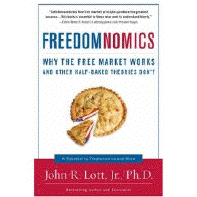
Well, I am glad that my book Freedomnomics mentions a couple of those explanations (I don’t have the one about the A-team). The competition explanation doesn’t seem right. You can see this phenomenon in DC with a whole row of restaurants right next to each other. Lunch might compete with “in-house cafeterias, the dirty water hot dog cart, chain restaurants, and delivery businesses,” but for dinner you are also less likely to eat right near where you work or live. Jonas M Luster has this discussion:

. . . Some things are static, such as my lease, power, linens, licenses, etc. Other things vary between lunch and dinner:

Lunch isn't prepared and served by my A-team. Many times waiters and cooks have to prove themselves during lunch before being allowed on the dinner line. This means I pay less in payroll.
Lunch doesn't usually serve a full menu. The menu is optimized for faster production and oftentimes smaller portioned. Smaller menu means less storage, smaller dishes mean less storage, and faster turnaround means less secondary storage costs (hot/warm holding, etc.)
Lunch diners spend an average of 45 minutes from entry to exit, dinner guests take over twice as long. This means faster turnaround during lunch hours, which either means more covers or less staff needed. Both saves me money.
Lunch guests don't want/need candles and expensive bottles of water. They want food. We cater to this by dropping down to the bare bone of fine dining hospitality, removing fluff.

Last, but not least, lunch is a competitive market. We compete with in-house cafeterias, the dirty water hot dog cart, chain restaurants, and delivery businesses. By pricing ourselves competitively we ensure good covers every day of the week (low day is Tuesday, high day is Thursday, by the way) and a hot, pre-stocked, kitchen for dinner. That saves us money (I don't have to pay someone to come in at 3pm and set up stocks and sauces, for example, I can have the lunch crew do those during slows and as part of their prep) and time, which in and by itself is money. . . .

Labels: , ,

12/03/2011

There will be fewer shortages of bone marrow

This will probably ensure that there will be some more people who won't die premature deaths. From the Wash Post:

A federal appeals court ruled Thursday that most bone marrow donors can be paid, overturning the government’s interpretation of a decades-old law making such compensation a crime punishable by up to five years in prison.

In its ruling, the 9th U.S. Circuit Court of Appeals said a technological breakthrough makes donating bone marrow a process nearly identical to giving blood plasma.

It’s legal — and common — to pay plasma donors. Therefore, the court ruled, bone marrow donors undergoing the new procedure can be paid as well and are exempt from a law making it a felony to sell human organs for transplants.

The unanimous, three-judge panel of the court did say it remains a felony to compensate donors for undergoing an older transplant method, which extracts the marrow from the donors’ bones. . . .

Labels: