10/25/2015

Tesla's Model S has a below-average reliability score, no longer considered a top pick from Consumer's Report

My guess is that a lot of the well to do people who buy Tesla cars don't have a lot of time to waste getting their cars fixed.  From CNN:
Tesla (TSLA)'s Model S earned a below-average reliability score in a recent Consumer Reports survey of owners. . . . . 
The bottom line is that the Model S is fun to drive, with great handling and amazing acceleration, but it also suffers from more than its share of annoying technical glitches, according to the magazine.  
About 1,400 Tesla owners surveyed complained of problems with the car's charging equipment, center console area and things like door and windows. They also had issues with the car's electric drive systems and they complained about rattles, squeaks and leaks in the sunroof.  
Tesla shares slid 10% shortly after Consumer Reports released the survey. . . .

Labels:

8/21/2015

Only 45% of electric vehicle owners this year have replaced their cars with a new electric vehicle


One measure of whether people liked their electric vehicles is whether they replaced them with a new one when they traded their old car.  By that measure, despite the massive subsidies, electric vehicles aren't holding up very well.  From Edmunds:
only 45 percent of this year's hybrid and EV trade-ins have gone toward the purchase of another alternative fuel vehicle, down from just over 60 percent in 2012. Never before have loyalty rates for alt-fuel vehicles fallen below 50 percent.  
"For better or worse, it looks like many hybrid and EV owners are driven more by financial motives rather than a responsibility to the environment," says Edmunds.com Director of Industry Analysis Jessica Caldwell. "Three years ago, when gas was at near-record highs, it was a lot easier to rationalize the price premiums on alternative fuel vehicles. But with today's gas prices as low as they are, the math just doesn't make a very compelling case."  
To underscore the point, Edmunds calculates that at the peak average national gas price of $4.67/gallon in October 2012, it would take five years to break even on the $3,770 price difference between a Toyota Camry LE Hybrid ($28,230) and a Toyota Camry LE ($24,460). At today's national average gas price of $2.27/gallon, it would take twice as much time (10.5 years) to close the same gap. . . .

Labels:

2/04/2015

A big hidden cost of owning a Tesla, the cost of repairing a lightweight aluminum body

The Telsa's nearly all-aluminum frame and body panels make repair work on even a minor fender-bender difficult and very expensive.  From The Truth About Cars:
  • $45,000 for “minor front-end damage”
  • $7,000 for repair of a small dent and scratch that required no replacement of parts
  • $30,000 for “minor fender and door damage”
  • $11,000 for a minor scrape on the rear panel, including a $155 charge to “ensure battery remains charged” during the repair

Labels:

9/04/2014

Despite massive government tax and regulatory subsidies, Electric car sales are stalled

Not only is there a large tax credit per car, but the federal government subsidizes massively subsidizes electric cars via its MPG regulations (here and here).  From the LA Times:
Electric car sales are not charging the marketplace. A new study by online automotive research company Edmunds.com suggests the segment may have run out of gas.
Sales of electric drive vehicles are stuck at about 3.6% of all new car sales for 2014, Edmunds senior analyst Jessica Caldwell said.
That's below the 3.7% market share for 2013, and it's not likely to grow any before the end of the year.
And that's during an otherwise robust sales season. Total figures for August were higher than any time in the last decade.
Automakers sold about 1.6 million vehicles in the U.S. in August, an increase of about 3% from August 2013, according to initial industry estimates released Wednesday.
"The whole automobile market has grown," Caldwell said. "We’re not seeing electric vehicles as part of that growth." . . .

Labels:

3/20/2014

If you were already concerned by the short distances that electric cars could cover, here is some advice

If you were already concerned about the short distances that electric cars could travel, do not go in either frigid or hot temperatures.
The average EV battery range in AAA’s test was 105 miles at 75 degrees but dropped 57% to just 43 miles at 20 degrees. Heat also sliced the cars' ranges but by not as much: The cars averaged 69 miles per full charge at 95 degrees, 33% less than in 75-degree weather. . . .
If there is a 57% drop between 75 and 20 degrees, what happens if it gets really cold?  I would assume that the distance drops even further.  If the relationship is linear, these first two observations imply a distance of only 20 miles at a temperature of zero.  My guess is that things are even worse than that as the drop off may increase with lower temperatures.

Labels:

12/29/2013

Racing electric cars?: Just too funny, this seems guaranteed to stop buying electric cars

Limits on speed.  Having to change cars every 20 minutes!  Possibly they will even have a few battery fires.  What else could there be to constantly remind people why they won't want to drive these electric cars.  From the UK Telegraph:
If you think the atmosphere at a Formula 1 grand prix is electric, you’re going to love the new motor sport starting next year. Formula E will see drivers racing around city-centre circuits - including London - in battery-powered electric cars. The new championship, which is backed by the FIA, motor racing’s governing body, promises cars as sexy as those driven by Lewis Hamilton, Sebastian Vettel et al, but with lithium-ion batteries and electric motors instead of fuel tanks and pistons. And, while their top speed is expected to be 155mph, slower than Formula 1, the event will compensate with exciting street circuits and brightly-lit night events. The pit stops will be different too: with the batteries running out of juice after 20 minutes, drivers won’t just change their tires, they’ll jump into new cars. The season is scheduled to start on September 13 in Beijing, with further races in the streets of Rio de Janeiro, Berlin and Los Angeles amongst others, before the final event in the centre of London on June 27 2015. . . .
The WSJ just also happens to have this discussion of the Porsche 918 Spyder  ($845,000, 211 mph top speed), which contains electric motors.  It is amazing that the battery in this hybrid is depleted after just one lap at racing speeds.
In September the 918 Spyder development team shattered the Nürburgring production-car lap record, with a time of 6:57 minutes, a half-minute quicker—a half-minute!—than the Porsche Carrera GT. The 918 Spyder is stunning, defining, a sports car immortal with 18 miles of all-electric range that also gets an estimated 79 miles per gallon. 
Except that it games the Nürburgring record. Project leader Frank Walliser explained to me that in fundamental ways—for example, the size, weight and output of the car's 6.8-kwh, 385-volt lithium battery—the car's systems were purpose-built and scaled precisely to exceed this one number on the Nürburgring's 14-mile Nordschleife track. With the car in "Hot Lap mode," it takes one Nordschleife lap to deplete the battery; after that, the roughly 660 pounds of EV powertrain becomes dead weight. . . .  
This seems to violate a principle of design purity that a machine performs the same through its range of operation. The car is artificially fast on the "Ring." For me, the 918's Nürburgring lap record will always have an asterisk. . . .

Labels:

12/26/2013

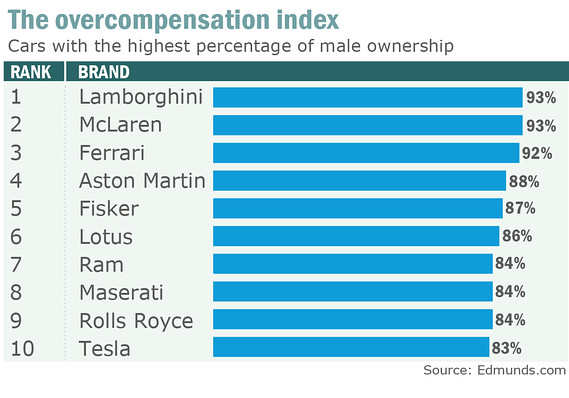
Do men buy impractical Electric Car as a way to fix their "anxieties and inadequacies"?

Here is a MarketWatch article claiming that “Women car shoppers tend to be more pragmatic."  More details are provided here:
Though it’s hard to make generalizations about consumer taste, Men appear to choose their cars as they would choose a watch or cologne, Henry says, based on how it makes them feel and the image it presents to the world. For instance, brands with a rich heritage like Lincoln, Buick, Cadillac and Mercedes-Benz particularly draw the attention of older men, Henry says. (Men are 17% more likely than women to shop for a Lincoln, KBB’s study found.) Many of them grew up with the automaker as an aspirational luxury brand, he says. Perhaps less surprisingly, brands that promote themselves as being “rugged” in advertising campaigns draw the interest of men of all ages, he says. 
Women, on the other hand, tend to choose cars based on fuel-efficiency and price. Some 72% of women say they’ll consider affordability in their next purchase compared with 50% of men, according to a survey by Kelley Blue Book, while 67% of women are more likely to consider fuel-efficient cars — such as Kia, Mini, Mazda and Honda — versus 48% of men. And women appear to prefer less flashy colors: They’re 9% more likely to choose silver or brown models, while men are 12% more likely to go for cars in red and orange, according to an analysis of buyers by used-car dealing site iSeeCars.com. . . .
So are men buying electric cars because they like impractical cars that make them feel better about themselves and make up for their perceived inadequacies?  A Tesla or a Fisker may just a way to make men feel better about themselves in the same way that a Maserati and Lotus solve their emotional problems.

Labels:

10/18/2013

Electric and plug-in hybrid vehicles account for less than half of one percent of the overall car market

Fewer than one out of every 200 cars is either a hybrid or an electric car, with most being hybrids.  With the large subsidies given these cars, these sales are pretty pathetic.  From the Wall Street Journal:
. . . Analysts and industry executives say Tesla, GM, VW and the current global electric vehicle sales leader, Nissan Motor Co., all face the same problem: current electric vehicle batteries are too expensive, and deliver too little usable driving range compared with vehicles powered by internal combustion engines. 
The number of electric and plug-in hybrid vehicles for sale in the U.S. has more than quadrupled to 15 vehicles since 2010 as auto makers roll out new models to comply with government mandates. But sales of electric and plug-in hybrid vehicles account for less than half of one percent of the overall market, despite price cuts, discounted leases and government tax incentives that can add up to as much as $12,500 a vehicle depending on the state. 
GM has sold nearly 15,000 of its battery-powered Chevrolet Volt cars this year through August, aided by incentives and discounts. 
Nissan's approach is to argue that extending the range of electric vehicles to 200 miles isn't worth it because most people don't drive farther in a day than the Nissan Leaf's 75 miles of all-electric range. The Leaf costs $28,800 in the U.S. before federal tax credits.
Tesla is the lone auto maker to offer long-range electric vehicles with its Model S—and Tesla still hasn't shown it can steadily make money selling them. . . . .

Something amusing:

Top Gear: Jeremy drives the Tesla Roadster (series 12, episode 7)


Labels:

8/22/2013

Telsa Model S' battery costs $30,000 to replace when it no longer holds enough of a charge

Telsa claims that the battery in the Model S will last about ten years.  Still let's hope you don't do anything that will cause it not to hold enough of a charge.  A new battery pack for the car costs $30,000 (see also this here).  Of course, batteries do slowly lose their charge so you might simply find that the car has 90% of the range that it used to have after a couple of years.  Telsa does offer an option where you can pre-pay $12,000 when you buy the car to have a battery replaced when you need it.  That means the price of the car is really $92,000, not the $80,000 advertised.

Labels:

5/27/2013

President of an electric car company advocates a higher tax on gasoline

Isn't this obviously self serving?  So does anybody believe that these environmental firms aren't pushing for public policy that increase their profits?  From The Hill newspaper:

Tesla Automotive CEO and co-founder Elon Musk said climate advocates need to “reframe” the argument on climate science. . . .
Musk also said he had a solution — albeit one Republicans have outright rejected — for reducing carbon emissions.
“The thing they’ve got to do is try to put a tax on carbon,” he said, inducing cheers. . . .

Labels: ,

5/17/2013

Even after massive government subsidies, Fiat is losing about $10,000 on each of the tiny electric cars that it sells


At about 1:55 into the video the host notes that Fiat is losing $10,000 for each of the Fiat 500es that are sold.

Labels: ,

4/06/2013

Some reasons not to buy an electric car

From Fox News:
. . . But I wouldn’t buy an electric car if you paid me. Here’s why: . . .    
It isn’t cost effective. I spent my career in the high-tech industry. When I tell you that it’s smart to be a late adopter of anything new, especially technology, you should listen. In time, competition increases, prices come down, and reliability goes up. Let rich people like rock stars and actors buy Teslas and Volts.    They’re not for you. . . . 
You have to plug it in. Hybrids are great. They’ve come down the technology learning curve. They’re actually more efficient than standard gas powered engines. They deliver more bang for the buck. They don’t have to be subsidized. And, more importantly, you don’t have to plug them in. Ever. 
The whole government subsidy thing. I bought a solar array. It was government subsidized. Do I think it should have been? No. But for our needs, solar power made fiscal sense. I’m not going to cut off my nose to spite my face. Do I think the U.S. government should subsidize specific companies like Solyndra and Fisker? No. That’s just plain idiotic. That’s for venture capital and private equity firms with limited partners with beaucoup bucks and high risk tolerance, not for a government that owes $17 trillion or American taxpayers who can’t pay their bills.   
Who says electric power is clean? When China has electric cars, they will be powered by electricity from coal plants that pollute the atmosphere, big-time. The assumption that, just because a car is electric, it must be green, clean, renewable, whatever, is nonsense. Just to be clear, I don’t have a problem with where our electricity comes from. I think we should drill, frack, and nuke to our heart’s content. I want America to actually export energy. What I don’t get is why anyone would think an electric car is in any way greener than a hybrid. It’s not.    
I don’t like dumb fads. I guess the bottom line is that I don’t like the color green for the sake of being green. In other words, I don’t like fads, especially fads that are fueled by overblown hypocrites and bad science. In case you’re wondering, by “hypocrites,” I mean Al Gore. And by “bad science,” I mean man-made global warming, climate change, or whatever the hypocrites are calling it these days. . . .

Labels: ,

Fisker: Another government investment is about to go bankrupt after a half-billion-dollar federal loan

It has been clear for well over a year that Fisker was having trouble.  From Fox News:
Fisker Automotive -- the electric-car maker that was granted a half-billion-dollar federal loan and on Friday dismissed about 75 percent of its remaining workforce -- is purportedly facing a lawsuit from the same firm that sued the government-funded Solyndra company. . . . 
Employees told the publication they were give no severance pay besides compensation for unused vacation days. . . .  
A source told the news agency that Fisker will retain about 53 senior managers and executives to primarily help sell off company assets. 
Fisker has received $193 million of a $529 million Energy Department loan, mostly for work on its luxury Karma vehicle that sells for about $100,000. The deadline to repay the loan is purportedly in late April. . . .

Labels: , , ,

2/12/2013

The perils of driving electric vehicles during the winter

Is 30+ degrees really that cold?  That was the first day and it was bad enough.  Over night the temperature fell to 10 degrees. This Telsa Motors car left a lot to desire.  Could you image what this trip will be like after the batteries are a few years old and are not keeping their charge as well as new ones do?  Just think, you too can have this experience for a mere $61,000 (plus tax).  From the NY Times:
But as I discovered on a recent test drive of the company’s high-performance Model S sedan, theory can be trumped by reality, especially when Northeast temperatures plunge. . . . 
I noticed that the estimated range was falling faster than miles were accumulating. . . . 
I began following Tesla’s range-maximization guidelines, which meant dispensing with such battery-draining amenities as warming the cabin and keeping up with traffic. I turned the climate control to low — the temperature was still in the 30s — and planted myself in the far right lane with the cruise control set at 54 miles per hour (the speed limit is 65). . . . my feet were freezing and my knuckles were turning white. . . .
I drove a state-of-the-art electric vehicle past a lot of gas stations. I wasn’t smiling.Instead, I spent nearly an hour at the Milford service plaza as the Tesla sucked electrons . . .  
I drove, slowly, to Stonington, Conn. . . . a total distance of 79 miles. When I parked the car, its computer said I had 90 miles of range, twice the 46 miles back to Milford. It was a different story at 8:30 the next morning. The thermometer read 10 degrees and the display showed 25 miles of remaining range — the electrical equivalent of someone having siphoned off more than two-thirds of the fuel that was in the tank when I parked. 
I called Tesla in California, and [was told] I needed to “condition” the battery pack to restore the lost energy. That meant sitting in the car for half an hour with the heat on a low setting. . . .  
After completing the battery conditioning process, the estimated range reading was 19 miles; no way would I make it back to Milford. . . .
UPDATE: "Tesla CEO accuses New York Times of printing 'fake' car review"

UPDATE: Apparently Tesla can monitor driver's behavior in unnerving detail.
. . . The most interesting tweet to me was the one captured above, where Musk refers to Tesla’s ability to monitor everything that a driver does in one of its cars — at least when it comes to the car’s operation.  “Tesla data logging is only turned on with explicit written permission from customers,” tweeted Musk. “But after Top Gear BS, we always keep it on for media.” 
(“Top Gear BS” refers to a 2008 BBC review of a Tesla car that the company also disputed and eventually sued over.) 
Thanks to more and more of our belongings being “smart” — or “tethered” as Jonathan Zittrain calls them — they’re constantly capturing data about us and in some cases reporting back to the companies that made them how we’re using them. It means your car might keep a log of how you drove it or that your Xbox might be tracking every person in the room and watching their facial expressions to decide which ads to show them. 
Tesla says it always asks for customers’ permission before doing this –even if that’s not made clear in the owner’s manual — but journalists taking a car for a free spin don’t get that same courtesy. . . . 

Labels:

7/06/2012

Despite huge government subsidies, the sales of electric cars are horrible

GM had predicted that there would be 45,000 sales of Volts this year.  Nissan had predicted sales of the leaf at 20,000.  Yet, during the first six months, only 8,817 were sold.  20 percent are being sold in California in part because of benefits such as being able to drive in the carpool lanes with only one person in the car.  But, even if the Volt sales are horrible, the Volt is outselling the all-electric Nissan Leaf by more than 3 to 1.


Labels: ,

5/12/2012

Another electric car catches fire, destroys home and other cars

A Texas man got a rude surprise from his new electric car:

A $100,000 electric car is suspected in sparking a fire at a Sugar Land home last week, according to media reports.
Fort Bend County chief fire investigator Robert Baker said that a newly purchased Fisker Karma sparked a fire that quickly spread to the rest of the home.
“The Karma was the origin of the fire, but what exactly caused that we don’t know at this time,” Baker told the news outlet.
Since the fire was determined to be accidental, Baker said the investigation has been turned over to the insurance companies.
According to his lawyers, Jeremy Gutierrez said his two-week old Karma caught fire soon after he parked the luxury sedan at his home in Sugar Land. The car owner said he smelt rubber rubber before seeing flames coming from the vehicle. The fire spread from the car to the garage before damaging other parts of the home. . . .

Labels:

5/11/2012

More than twice the cost, able to travel a fraction of the distance: why not to buy electric cars

Component costs alone are $38,462? Add in assembly, shipping, and inventory costs and I guess that the margin is actually lower on this electric car than the gas powered vehicle.  From Bloomberg:

Tesla Motors Inc. (TSLA), the electric-car company led by Elon Musk, fell to the lowest price in more than three months after Toyota Motor Corp. (7203) said its RAV4 sport- utility vehicle with batteries and motor from Tesla costs twice as much as a gasoline version. . . .
“The details of the RAV4 EV that Toyota gave out yesterday were a little disappointing,” said Ben Schuman, an analyst with Pacific Crest Securities in Portland, Oregon, . . . . The manufacturer’s suggested retail price “is a little bit high to make it appealing to a larger buyer group.”
Toyota said yesterday the electric RAV4 that goes 100 miles (161 kilometers) per charge will sell for $49,800 when it goes on sale this year in California. The Toyota City, Japan-based company, a Tesla investor, plans to deliver 2,600 units over the next three years, . . . .
The base price of a 2012 RAV4 with a 2.5-liter gasoline engine is $22,650 on Toyota’s website.
Toyota in July 2011 agreed to pay Tesla a total of $100 million to supply lithium-ion battery packs, motors, software and other parts for the RAV4 project, part of a three-year contract, according to a filing by Tesla with the Securities and Exchange Commission. Based on Toyota’s 2,600-unit sales goal for the model, it’s paying $38,462 for components per vehicle. . . .

Labels: ,

3/09/2012

More problems for another electric car, the $100,000+ Fisker Karma

The Orange County Register notes that a Fisker Karma that Consumer Reports was testing completely died on them after 180 miles. The company got a $529 million loan from the U.S. Department of Energy.

Labels:

3/02/2012

Expensive Electric Cars Selling Very Poorly

From CNET:

In terms of price, the Focus Electric costs just under $40,000 before a $7,500 federal tax credit. The Nissan Leaf's price starts at $35,200. The electric Chevy Volt, which has a gas engine to extend the range, costs just under $40,000 and the low-end version of Toyota's 2012 Plug-in Prius is $32,000.
Next year, Ford intends to release the Fusion Energi plug-in hybrid, a mid-size sedan Ford expects to top 100 MPGe and the Fusion Hybrid sedan which Ford projects will get 47 MPG.
The introducing of the Focus Electric brings more competition to the electric car segment. At the same time, all electric cars which run on expensive batteries face competition from hybrids and more efficient gasoline powered vehicles.
In its first year, sales of GM's Chevy Volt fell short of the company's targets, having sold 7,671 in 2011 and 9,297 to date. Nissan, which is now making the Leaf available nation-wide, said in February that it sold 10,000 Leafs in North America.


Sales apparently even slowed further in January:

Sales of the Chevrolet Volt and Nissan Leaf dipped in January, with Volt sales apparently hit by a now-closed safety investigation.
The volume of these high-profile electric cars sold is closely watched as a barometer of consumer demand. Several more battery-electric and plug-in hybrid models from other automakers are expected to come out this year and next.
General Motors said yesterday it sold 603 Volts in January of this year, more than the 321 it sold in January last year. GM shipped 1,529 Volts in December last year, its best month since production, although the yearly total of 7,671 was less than it had hoped.
Nissan sold 676 all-electric Leaf sedans in January of this year, less than the 954 it sold in December last year. The company hit a volume of 10,000 in North America this month. . . .


UPDATE: "GM temporarily halts production of Volt"

General Motors has temporarily suspended production of its Volt electric car, the company announced Friday.

GM, which is based in Detroit, announced to employees at one of its facilities that it was halting production of the beleaguered electric car for five weeks and temporarily laying off 1,300 employees.

A GM spokesman told The Hill on Friday that production of the Volt would resume April 23.
"We needed to maintain proper inventory and make sure that we continued to meet market demand," GM spokesman Chris Lee said in a telephone interview. . . .


Blames media for the low sales.

"GM blamed the lack of sales in January on “exaggerated” media reports and the federal government's investigation into Volt batteries catching fire, which officially began in November and ended Jan. 21," . . .

Labels: , ,

2/23/2012

Problem with Tesla Motor's $40,000 batteries

Apparently this problem has occurred at least five times in the short time that the Roadster has been in service. Between 2008 and December 2011, Tesla has sold more than 2,100 Roadsters in 31 countries.

Tesla Motors’ lineup of all-electric vehicles — its existing Roadster, almost certainly its impending Model S, and possibly its future Model X — apparently suffer from a severe limitation that can largely destroy the value of the vehicle. If the battery is ever totally discharged, the owner is left with what Tesla describes as a “brick”: a completely immobile vehicle that cannot be started or even pushed down the street. The only known remedy is for the owner to pay Tesla approximately $40,000 to replace the entire battery. Unlike practically every other modern car problem, neither Tesla’s warranty nor typical car insurance policies provide any protection from this major financial loss.

Despite this “brick” scenario having occurred several times already, Tesla has publicly downplayed the severity of battery depletion risk to both existing owners and future buyers. Privately though, Tesla has gone to great lengths to prevent this potentially brand-destroying incident from happening more often, including possibly engaging in GPS tracking of a vehicle without the owner’s knowledge. . . . .

Labels: