1/04/2015

New York State claims that insomnia is sufficient mental illness for retired cop to have his guns taken away

A decorated retired New York cop is suing the state for taking away his guns.  From Fox News:
. . . Donald Montgomery’s lawsuit contends that Gov. Andrew Cuomo and other state officials violated his Second Amendment rights when his guns were seized after a brief hospital stay for insomnia. Montgomery, a cop for 30 years and a U.S. Navy veteran, brought the lawsuit in Rochester Federal Court on Dec. 17, according to the Daily Caller. 
The SAFE Act became law with little public debate after Cuomo convinced lawmakers that New York needed to do something after the mass shooting at the Sandy Hook elementary school in Newtown, Conn. 
Montgomery was the owner of four guns -- a Colt .38 handgun, a Derringer .38, a Glock 26 9-mm. and a Smith & Wesson Bodyguard 380. 
His troubles started when he visited a Long Island hospital in May complaining of insomnia. He was discharged with a diagnosis of “depression, insomnia” and then returned a short time later for a 48-hour stay. The lawsuit says that during that visit, staff erroneously listed him as an “involuntary admission,” triggering the SAFE Act reporting provision. Those deemed at-risk for owning guns by mental health professionals have to be reported and their names entered into a database. 
The lawsuit claims Montgomery should not have been reported because he was not a threat to himself or others. The suit says a hospital psychiatrist told him “You don’t belong here” and “I don’t know why you were referred here.” . . .

Labels: ,

12/19/2014

U.S. Appeals Court says that just because you once had a mental illness problem doesn't allow government to ban you for life from owning guns

The risk of violence from people with mental illness is extremely low to begin with, but if the risk is low even when people are suffering a mental illness, why ban them for ever from owning a gun, even after they are cured?  From the Wall Street Journal:
In the first legal ruling of its type, a federal appeals court in Cincinnati on Thursday deemed unconstitutional a federal law that kept a Michigan man who was briefly committed to a mental institution decades ago from owning a gun. 
A three-judge panel of the Sixth U.S. Circuit Court of Appeals unanimously ruled that the federal ban on gun ownership for anyone who has been “adjudicated as a mental defective or who has been committed to a mental institution” violated the Second Amendment rights of Clifford Charles Tyler, a 73-year-old Hillsdale County man. 
“The government’s interest in keeping firearms out of the hands of the mentally ill is not sufficiently related to depriving the mentally healthy, who had a distant episode of commitment, of their constitutional rights,” wrote Judge Danny Boggs, an appointee of President Ronald Reagan, for the panel. 
Lucas McCarthy, Mr. Tyler’s lawyer, called the ruling “a forceful decision to protect Second Amendment rights,” and said he hoped it that it would have “a significant impact on the jurisprudence in the area of gun rights.” . . .

Labels: ,

8/07/2014

By almost 2-to-1 vote, Missouri approves stronger constitutional protections to own guns

Bloomberg's gun groups claimed that this change would hurt safety in Missouri.  Voters overwhelmingly rejected the claims.  An explanation of the changes to the Missouri Constitution are available here at KFVS Channel 12:
Missourians voted to strengthen the state's gun rights law when they headed to the polls on Tuesday, Aug. 5.  This ballot measure reads as follows:

"Shall the Missouri Constitution be amended to include a declaration that the right to keep and bear arms is an unalienable right and that the state government is obligated to uphold that right?"
Currently, the U.S. Constitution grants American's the ability to keep and bear arms.
Missouri state law also protects that right.
 
Essentially, voters were asked to decide if this right to keep and carry guns should be an "unalienable right" just like American's rights to life and liberty. 
That would mean the right is impossible to take away and if it was challenged in court, this amendment would give Missourian's the highest level of legal protection.
Senator Kurt Schaefer, a supporter of the change, says if passed, Missouri would have the strongest gun rights in the country. . . .
The St. Louis Post has this discussion of the outcome of the vote:
And Amendment 5, reitervating the U.S. Constitution’s right to bear arms, won by almost 2 to 1. . . . 
The “right to bear arms” referendum (Amendment 5) will reiterate the U.S. Constitution’s similar guarantee, but with more specificity, making that right “inalienable.” Supporters argued it was needed because of attempts to restrict gun rights on the national level. 
Opponents argued that it would be an unnecessary duplication of the federal Constitution’s Second Amendment and that it could impede enforcement of reasonable firearms restrictions. 
After the vote, the group “Moms Demand Gun Sense in America” issued a statement warning: “Today Missouri voters approved a gun lobby-backed proposal that could gravely undermine public safety.” . . .

Labels: ,

7/13/2014

Could the writers of The Bill of Rights have anticipated modern guns? Meet the auto cannon, the Puckle gun, from 1718

Click on pictures to enlarge them.

Here is a gun from 1718 that can fire 9 or so cannon shells very rapidly.  Once the principle was developed the number of shells that could be quickly fired could be increased even more.  The Puckle gun was developed long before the Gatling gun in 1862.  If a auto cannon was developed well before The Bill of Rights, how could it be claimed that they couldn't foresee machine guns and other modern weapons?

It is pretty clear that the Royce Wilson article has a typo/error when it says that metallic cartridges weren't developed until the 1950s.

Labels:

5/08/2014

Missouri to vote on revised state constitutional protection of right to keep and bear arms

In the next election, the voters in Missouri will vote on this amended wording.  From the Washington Post:
That the right of every citizen to keep and bear arms, ammunition, and accessories typical to the normal function of such arms, in defense of his home, person, family and property, or when lawfully summoned in aid of the civil power, shall not be questioned[; but this shall not justify the wearing of concealed weapons]. The rights guaranteed by this section shall be unalienable. Any restriction on these rights shall be subject to strict scrutiny and the state of Missouri shall be obligated to uphold these rights and shall under no circumstances decline to protect against their infringement. Nothing in this section shall be construed to prevent the general assembly from enacting general laws which limit the rights of convicted violent felons or those duly adjudged mentally infirm by a court of competent jurisdiction.
The current wording is as follows:
That the right of every citizen to keep and bear arms in defense of his home, person and property, or when lawfully summoned in aid of the civil power, shall not be questioned; but this shall not justify the wearing of concealed weapons. 

Labels:

4/14/2014

Justice Stevens' op-ed in the Washington Post unintentionally shows the 2nd Amendment wasn't aimed at protecting only government rights

Retired Supreme Court Justice John Paul Stevens has a new book out where he suggests what was originally meant by the 2nd Amendment.  From his op-ed in the Washington Post:
As a result of the rulings in Heller and McDonald, the Second Amendment, which was adopted to protect the states from federal interference with their power to ensure that their militias were “well regulated,” has given federal judges the ultimate power to determine the validity of state regulations of both civilian and militia-related uses of arms. That anomalous result can be avoided by adding five words to the text of the Second Amendment to make it unambiguously conform to the original intent of its draftsmen. As so amended, it would read: 
“A well regulated Militia, being necessary to the security of a free State, the right of the people to keep and bear Arms when serving in the Militia shall not be infringed.” . . .
Stevens would like to add five words and also a comma after the word "Militia."  But Stevens unintentionally shows what those who drafted the amendment would have to have written to make it clear that they wanted it only to apply to those in the militia.  There is a huge difference between "the right of the people to keep and bear Arms shall not be infringed" and "the right of the people to keep and bear Arms when serving in the militia shall not be infringed."  Both statements are quite clear, but while Stevens would like everyone to believe that the 2nd Amendment was written as only a militia right.


Labels: ,

2/22/2014

Former Supreme Court Justice John Paul Stevens unintentionally shows that the 2nd Amendment wasn't meant to just guarantee weapons for the militia

The Second Amendment reads: "A well regulated militia being necessary to the security of a free state, the right of the people to keep and bear arms shall not be infringed."

Stevens would like to add five words and also a comma:

“A well regulated Militia, being necessary to the security of a free State, the right of the people to keep and bear Arms when serving in the militia shall not be infringed.”

Stevens unintentionally shows what those who drafted the amendment would have to have written to make it clear that they wanted it only to apply to those in the militia.  There is a huge difference between "the right of the people to keep and bear Arms shall not be infringed" and "the right of the people to keep and bear Arms when serving in the militia shall not be infringed."  Both statements are quite clear, but while Stevens would like everyone to believe that the 2nd Amendment was written as only a militia right. 

Labels:

2/21/2014

San Diego Sheriff's office decides not to go for an "en banc" appeal of the recent Appeals Court decision striking down part of California's Concealed Carry law

The press release from the Sheriff's office reads this way (2/21/2014 2:46:13 PM):

Today, San Diego County Sheriff Bill Gore notified the County Board of Supervisors ofhis intention not to seek en banc review in the matter Peruta, et.al v. County of San Diego. Acopy of Sheriff Gore's letter to the Board of Supervisors is below. 
Members of the public wishing to obtain a CCW under the standards articulated by the Ninth Circuit should be aware that the decision has not yet become final. Federal court rules prescribe a period of time which must elapse before the case is remanded to the District Court for further proceedings. Should the decision of the Ninth Circuit become final, the Sheriff's Department will begin to issue CCWs in situations where the applicant has met all other lawful qualifications and has requested a CCW for purposes of self-defense. 
Additionally, those seeking a CCW are advised that the process for obtaining a CCW involves several steps. The application process includes a scheduled interview, payment of fees, as well as state and local background checks. Successful completion of a firearms course of training is also required. This process can take several months. . . . 
So what does this mean?  I discussed last week, the Appeals Court decision struck down the so-called “good cause” requirement for getting a permit, saying that concern for one’s personal safety should be sufficient justification.  I thought that there was a chance that the decision wouldn't be challenged because a win by gun control advocates at the Ninth Circuit would surely lead to an appeal to the Supreme Court.  If I had a choice of cases, the California case is the one that I would appeal simply because some counties in California are so incredibly restrictive on issuing permits.  It seems that gun control advocates may have won out on influencing the legal strategy here.

Meanwhile, Orange County, California has responded by loosening up its permitting requirements.  The Los Angeles Times reports:
But Orange County Sheriff Sandra Hutchens announced on the department's website that the county has decided to comply anyway.
"Regardless of what her personal positions are, she feels she needs to abide by what the law is," Lt. Jeff Hallock, a sheriff spokesman, said Thursday.
He said the department has received "a huge influx" of requests for permits to carry concealed guns since the 9th Circuit ruling. He cautioned, though, that the new relaxed rules might be "revisited" if the court decision is appealed or overturned.
The Orange County Sheriff's Department, which handles gun carry permits for the county's cities, will now give residents permits if they simply cite a need for personal safety or self-defense, as long as other conditions are met, the department said. Those conditions include an interview, background check, completion of a firearms training course and a fee.
"I am thrilled that the sheriff has seen the writing on the wall and recognized that Orange County citizens should have the right to choose to carry a firearm to protect themselves," said Chuck Michel, a National Rifle Assn. lawyer who represented gun owners in the 9th Circuit case. . . .

Labels: ,

12/26/2013

Florida University won't appeal court decision that universities regulations guns on can't supersede state laws

The recent Florida Appeals court decision allowing guns being stored in cars parked at universities will make it possible to take guns with them to and from school.  The News Service of Florida:
The University of North Florida will not appeal a court ruling that struck down a policy preventing students from storing guns in their cars on campus. 
Sharon Ashton, the university’s vice president for public relations, sent an email Friday to students, faculty and staff informing them of the decision. 
“Earlier this month, the 1st District Court of Appeal ruled that UNF can’t prohibit students from keeping securely encased guns in cars parked (on) our campus and we have decided not to appeal that decision,’’ Ashton wrote. “Students still cannot carry a gun onto or on our campus, but can now legally keep a gun securely encased in their vehicle parked at UNF.” 
The appeals court ruled Dec. 10 in favor of a UNF student and the group Florida Carry Inc., which challenged the policy. 
Florida Carry Inc. Executive Director Sean Caranna said the university contacted the group’s attorneys Friday afternoon with its decision. . . .
From CBS Miami:
. . . The appeals court decision stated that FSU, along with the University of Florida and the University of South Florida had regulations identical to UNF. A spokeswoman for Florida International University said Monday that the Miami-based university also had rules that prohibited keeping a gun in a car. 
Officials with UF and USF did not immediately respond to requests for comment.
Brittany Davis, a spokesman for the Florida Board of Governors, said that the State University System has not distributed the ruling to the universities. But Davis noted that not all universities have gun policies similar to the UNF policy. 
Florida law currently makes it illegal to possess or exhibit guns at schools and universities and permits school districts to prohibit guns from being stored in cars. The court rejected arguments by UNF attorneys that universities, like school districts, could ban guns in cars. . . .  

Labels: , ,

12/13/2013

Florida appeals court moves to let people carry permitted concealed handguns on college campuses

A copy of the court decision is available here.  The very long article in Inside Higher Education starts this way:
A divided Florida appeals court ruled Tuesday that public colleges and universities -- except in limited circumstances -- lack the legal right to regulate gun possession on campus. 
The ruling came in a case involving a rule at the University of North Florida banning students from keeping guns in their cars. But the appeals court went beyond that rule (which it rejected) to speak more generally to the right of public colleges and universities to limit gun possession on campus, as local news media indicated they do. Under Florida's Constitution, the appeals court found, only the Legislature can make such restrictions, so most rules imposed by public colleges and universities would be invalid. 
The university had argued that a specific exemption in Florida law giving school districts the right to regulate guns in their facilities applied to public universities as well. The appeals court rejected that argument, saying that lawmakers specify different types of educational institutions in their regulations, so that references to school districts cannot be assumed to go beyond elementary and secondary education. 
The dissent to the ruling said that that the appeals court's ruling leaves public universities "powerless" to deal with guns on campus and that the decision "defies common sense."
The ruling in the case was 12-3 (with several concurring opinions) and could be appealed to the Florida Supreme Court, but university officials have not indicated whether they will do so. . . . 
In an interview with First Coast News ABC, Lainez said, "As a single mom, I do travel from school and I feel that it's important for myself and many other students who are also concealed weapons license holders to be able to carry our guns when we go to school."
Here is an old piece that I have about gun free zones in Florida.

Labels: , ,

11/12/2013

Question: if a two cent tax on newspapers and requiring an ultrasound before abortions are deemed unconstitutional infringements on rights, what about everything required for guns?

In 1936, the Supreme Court struck down a two percent tax on newspapers as "unconstitutional under the due process of law clause because it abridges the freedom of the press" (Grosjean v. American Press Co., Inc.).
For abortions, requiring an ultrasound before an abortion is deemed to impose to great of a burden on those seeking an abortion.  The Supreme Court just turned down an appeal from the state of Oklahoma on this issue.
The rejected Ultrasound Act stipulated that at least one hour before an abortion physicians must 1). perform an ultrasound 2). explain what it depicts 3). show the pregnant woman 4). provide a medical description “which shall include the dimensions of the embryo or fetus, the presence of cardiac activity...the presence of external members and internal organs….”
Interestingly, ultrasounds are generally promoted as being simple for women.  During the "first trimester fetal ultrasound typically takes between 15 and 20 minutes" and during the "second trimester ultrasound, completed between 18 and 22 weeks, is usually the longest procedure, lasting 30 to 45 minutes."  The typical cost of an ultrasound is "around $200."

So, are a woman's reproductive rights greater than a woman's right to her own life?


Yet, in Washington, DC it takes 5 hours of training to get a license and register a gun.  One must also take a 20-question exam on DC's firearms laws and regulations.  You must also give your fingerprints and submit a pre-owned firearm for ballistics testing at the office.  Additional cost include having to take the forms in in person.  The total dollar cost is over $500.


Alito in Chicago v. McDonald: "In sum, it is clear that the Framers and ratifiers of the Fourteenth Amendment counted the right to keep and bear arms among those fundamental rights necessary to our system of ordered liberty."  Scalia in Heller also referred to these rights as "fundamental."


Bottom line: How can a 20 minute test that costs $200 be deemed of as imposing an undue burden on a right, but a 5 hour training requirement and many hours of filing out forms and delivering them plus over $500 in fees not be considered such a burden?  How can a 2 percent tax on newspaper be deemed abridging the First amendment but what could easily be over a 100 percent tax on a gun be viewed as OK?


The court in Grosjean v. American Press Co., Inc. struck down the newspaper tax because it was reducing circulation of what it deemed to be a "fundamental right" ("it is seen to be a deliberate and calculated device in the guise of a tax to limit the circulation of information to which the public is entitled in virtue of the constitutional guaranties").  The tax on gun and ammunition purchases would seem to have the exact same effect on guns.

Labels: , ,

10/30/2013

Stunning: Retired Supreme Court Justice John Paul Stevens Doesn't Understand Difference between Machine Guns and Semi-automatic guns

This C-SPAN clip shows Justice Paul Stevens explaining that since the Supreme Court recognizes the right of the federal government to ban machine guns, it is possible for the "automatic weapons" used in mass shootings in the US.
Justice Stevens: "the 2nd Amendment provides no obstacle to regulations prohibiting the sort of automatic weapons used in the tragic multiple killings in Virginia, Colorado and Arizona in recent years."
The reference that Stevens is making at the beginning of the clip is to Justice Scalia's opinion in Heller stating:
That would be a startling reading of the opinion, since it would mean that the National Firearms Act’s restrictions on machineguns (not challenged in Miller) might be unconstitutional, machineguns being useful in warfare in 1939. We think that Miller’s “ordinary military equipment” language must be read in tandem with what comes after: “[O]rdinarily when called for [militia] service [able-bodied] men were expected to appear bearing arms supplied by themselves and of the kind in common use at the time.” 307 U. S., at 179. The traditional militia was formed from a pool of men bringing arms “in common use at the time” for lawful purposes like self-defense. . . .  We therefore read Miller to say only that the Second Amendment does not protect those weapons not typically possessed by law-abiding citizens for lawful purposes, such as short-barreled shotguns. . . . 
Obviously, this argument can't be made to semi-automatic weapons such as those used in the very attacks that Justice Stevens discusses for the very reason that semi-automatic weapons are indeed typically possessed by law-abiding citizens for lawful purposes.

How could Stevens write an opinion in the Heller case without him having a clue about the types of weapons that he was writing about?

Labels: ,

9/20/2013

Two very interesting rulings from the Illinois Supreme Court on the Second Amendment

From the Madison Record:

. . . The justices’ rulings came in the civil case of Jerry W. Coram v. State of Illinois and the criminal case of People v. Alberto Aguilar. 
Though the cases presented the court with different issues, both of the rulings could be seen as a shot to those seeking further restrictions on the right to own and possess guns.
The civil case focused on the denial of a man’s Firearm Owners Identification (FOID) card application while the criminal case dealt with a constitutional challenge to two sections of the state’s Aggravated Unlawful Use of Weapons (AUUW ) statute. . . . 
In his 2009 application for a FOID card, Coram included information that he had been convicted in 1992 of domestic battery. He pled guilty and was sentenced to 12 months’ conditional discharge. 
The state police denied his application based on an amendment to the federal Gun Control Act that imposed a firearm disability on individuals convicted of a domestic violence misdemeanor. 
In 2010, Coram petitioned the Adams County Circuit Court for a hearing on the denial of his FOID card application. The court then ordered the issuance of a FOID card, finding that he was not likely “to act in a manner dangerous to public safety.” . . . 
In its 53-page opinion that included separate opinions for a special concurrence and a dissent, the majority of the court upheld the lower court’s order directing the state police to issue Coram a FOID card. . . . 
The federal appeals panel in Moore held that Section 24-1.6(a)(1), (a)(3)(A) of the AUUW statue is “a flat ban on carrying ready-to-use guns outside the home” and as such, violates the Second Amendment right to keep and bear arms, as construed in Heller and McDonald. 
Thomas wrote for the court that “As the Seventh Circuit correctly noted, neither Heller norMcDonald expressly limits the second amendment’s protections to the home.” . . .
While it is not yet released, Nelson Lund has an interesting discussion on the Aguilar decision available from 9/18.

Labels:

4/09/2013

Survivor of Communism explains the importance of gun ownership by US citizens

Labels:

3/30/2013

A First Amendment challenge to gun control laws?

After the Sikh Temple attack at a gun free zone last year, it is understandable that Sikh's might feel that their traditional daggers are not enough to meet their religious obligation for self protection.  From the Washington Times:
A Sikh man is suing the state of California over its gun laws, arguing they violate his First Amendment rights to practice his religion by barring him from carrying the kind of weapons he says he needs for self-defense. 
Gursant Singh Khalsa, a practicing Sikh for 35 years, charges in the lawsuit filed this month that California’s laws banning military-style, semiautomatic weapons and high-capacity magazines violate mainstream Sikh doctinre requiring Sikhs “be at all time fully prepared to defend themselves and others against injustice.” 
“We’re required to wear what’s called a kirpan” or dagger, he said Thursday. “I feel, as far as my religion goes, it dictates that we should have all weapons of all kinds to defend ourselves. By not being able to carry an assault rifle or weapon that has a high-capacity magazine, I don’t feel that I can defend myself or my family.” . . .

Labels: , ,

3/27/2013

Three Republican Senators promise to filibuster Democrat Gun Control Bill

How just a few new Senators can make such a big difference in how the Senate operates.  These Senators are focusing on how these bills will hurt "citizens' right to self-defense."  A filibuster might give these Senators a real chance to educate people about exactly how these laws will cause harm.  From The Hill newspaper:
White House press secretary Jay Carney on Tuesday criticized three Senate Republicans who have threatened to filibuster Senate gun control legislation. 
Carney said a filibuster would be “unfortunate” and would send the wrong message to the families of gun violence victims. 
“I don't think you need to tell the families of those who have lost their children to gun violence that bills like this may be filibustered. I don't think that would be welcome news,” Carney said. 
GOP Sens. Rand Paul (Ky.), Mike Lee (Utah), and Ted Cruz (Texas) threatened to filibuster the bill in a letter to Senate Majority Leader Harry Reid (D-Nev.) that argued it was an infringement of Second Amendment rights. The bill would expand background checks and penalties on straw purchases of firearms. 
The senators pledged to “oppose the motion to proceed to any legislation that will serve as a vehicle for any additional gun restrictions.” 
“The Second Amendment to the Constitution protects citizens' right to self-defense. It speaks to history's lesson that government cannot be in all places at all times, and history's warning about the oppression of a government that tries,” they wrote. . . .

Labels: ,

2/25/2013

Is there a right to carry a gun? The 10th Circuit court of Appeals says no


The video is also available here.

A copy of the 10th Circuit's decision is available here.  The previous 7th Circuit decision is discussed here and here.

Labels: ,

12/13/2012

"Gun Decision Was Product of University of Chicago"

Edward McClelland with NBC Chicago has this claim:
. . . It was a University of Chicago professor, John Lott, who wrote the book "More Guns, Less Crime," which helped build the intellectual argument for conceal carry laws. Lott’s book was published in 1998, the year Chicago surpassed New York as the city with the most murders in the United States.

The 7th Circuit’s opinion was written by Judge Richard Posner, who has been on the faculty of the University of Chicago Law School in 1969. It has been suggested that the U of C faculty’s conservative outlook has a basis in geography: Hyde Park is an embattled island of gentility surrounded by water on one side, and poverty on the other three. It was interesting that Posner’s example of a Chicagoan who needs a gun to protect himself is a resident of Park Tower, a Gold Coast condominium where units run between $1.1 million to $5.7 million. As Posner put it, “a Chicagoan is a good deal more likely to be attacked on a sidewalk in a rough neighborhood than in his apartment on the 35th floor of the Park Tower.” . . .
I don't think that Posner is any particular friend of gun ownership.  One only has to look at his reaction to the Supreme Court's decision after Heller.  For several years while I was a law and economics fellow at the University of Chicago Law School, I lived in faculty apartments at the corner of Singleside Ave and E 60th Street, about a block west of the law school.  At least at the time, if one went a block or so further south, it was not exactly a very safe neighborhood.  One of our family friends was attacked right outside our apartment building.  He was clubbed in the head as he was trying to run away from his attackers and he was suffered severe brain damage.  I can't speak for Dick Posner, but he also lived at the University and anyone living on the South side of Chicago has to be cognizant of the crime problem.
Posner’s opinion was also an attack on federalism -- normally a cherished conservative principle. He argues that since every other state allows conceal carry, Illinois has no grounds for denying it. Is there, in the Constitution, a provision that automatically makes a law apply to every state once a certain number of states have adopted it? . . . .
Does McClelland think that the state of Illinois could ban publication of the Chicago Tribune or Sun-Times?  The 14th Amendment to the Constitution contains what is known as the incorporation clause, which applies the Bill of Rights to the states.  The idea of constitutional protections was that a majority of voters can't deny Americans certain rights.  McClelland doesn't seem to understand that defending constitutional protections is not inconsistent with being conservative.
There is a unique characteristic of criminal activity in Illinois: We have the city with the most murders in the United States. Murders are up over 25 percent this year. We surpassed the 2011 total on Oct. 29. That guns are responsible for this would be evident to anyone with an awareness of the streets of Chicago. But maybe not to someone whose Chicago is confined to the U of C Law Library.
McClelland ignores the ability of people to also use guns to protect themselves.  My research shows that poor blacks who live in high crime areas such as the South side of Chicago are the very people who benefit the most from having guns to protect themselves.

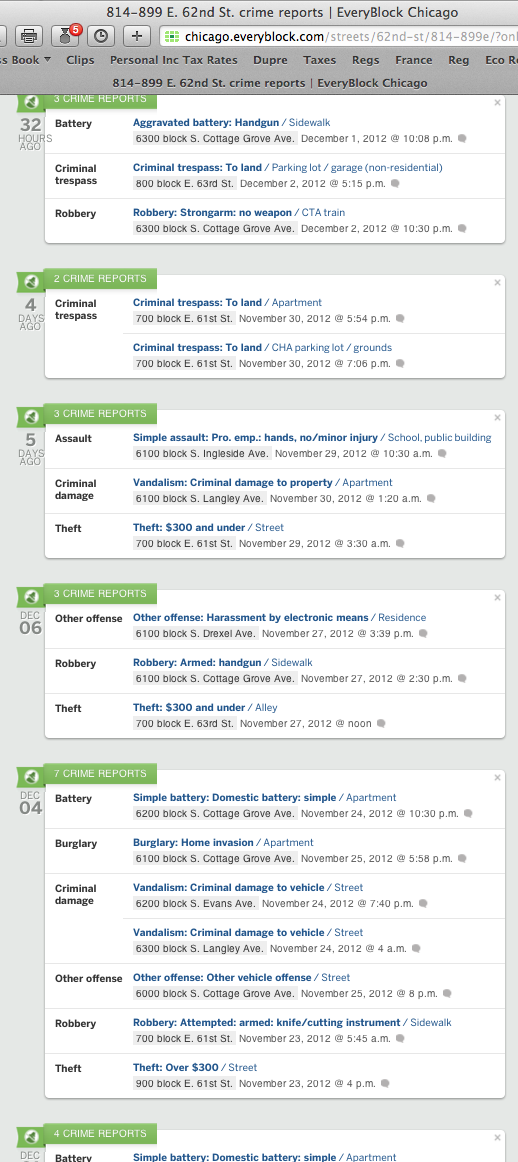
Here are some recent crime reports from an area one block from where we lived.  I would guess that the  University of Chicago has cleaned up the area a little since I lived there.  Click on the picture to make it larger.

Here are the crimes from a block going south down to Drexel.

Labels: , , ,

12/12/2012

Some background on other Concealed Carry Cases Around the country

After the 7th Circuit Court decision, here are some other recent cases.

Interesting oral arguments in Edward Peruta, et al. v. County of San Diego, et al., No. 10-56971
The various filings in the case are available here.
The McKay (Orange County) case documents are available here.
The Jackson (San Francisco) case documents are available here.

Labels: ,

11/24/2012

Updating the changes in DC's crime rates since Heller

Over the last few years, I have been chronicling how DC murder and violent crime rates have changed before and after the Supreme Court's Heller decision (see here and here).  The Supreme Court's decision came down the end of June 2008, though it took about a month for DC to change its gun laws.  So as to compare the same period of time each year before and after the ban, the following numbers look at the first seven months of each year.

What I have pointed out is that even though very few handgun permits have been issued (only a few thousand the last time that I looked), the big change in DC was the court striking down the ban on having loaded long guns in the District.  It had been a felony to chamber a bullet or a shotgun shell.  When the Supreme Court made its decision over 72,000 adults legally owned long guns.  After the decision, almost a quarter of the adult population were suddenly able to legally use those guns for self defense.

The Boston Globe has this story about the huge recent drop in homicides in DC, but the article fails to note that the drop started right after the Supreme Court decision.  How can one write a story on this without mentioning the court's decision?  The article mentions the crack epidemic.  Crack was indeed a problem, but that problem ended in the early 1990s.

Labels: , , ,