5/07/2007
Don Kates Responds to NY Times
I had previously posted on the NY Times article on whether the 2nd Amendment garantees an individual right to own a gun. Well, Don wrote up a much longer letter here. I wouldn't normally post something this long, but some may find the long list of journal articles of interest.
To the Editor
The pervasive inaccuracy of the N.Y. TIMES on gun issues is epitomized by the fact that "A Liberal Case for Gun Rights" is the most accurate treatment the Times has ever given the Second Amendment – and yet is still highly misleading.
From the article the ordinary reader would come away with the following misimpressions: 1) from its enactment in 1791 to roughly 1980 everyone viewed the 2nd Am. as a states right
or a meaningless "collective right"; 2) since 1980 a few ivory tower intellectuals have theorized that the Second Amendment might be a right of individual gun owners; 3) nonetheless the great majority of authorities say that is wrong.
The truth is almost diametrically opposite. Specifically:
1) From its enactment till the 20th Century gun control
movement the Second Amendment was universally understood as protecting an individual right to possess arms. Not one court or commentator asserted otherwise; 18th and 19th Century judges and commentators routinely described the Amendment as a right of individual gun owners and expressly analogized it to the rights of freedom of speech, religion, jury trial etc., etc. [See David B. Kopel "The Second Amendment in the Nineteenth Century," 1998 BRIG. YOUNG L. REV. 1359.]
2) The states’ right and collective rights theories are previously unknown artifacts of the 20th Century gun control movement having no constitutional provenance whatever. William Van Alstyne, a paramount figure in 20th-21st Century constitutional law, summarized the matter thus: "In recent years it has been suggested that the Second Amendment protects the 'collective right' of states to maintain militias, while it does not protect the right of 'the people' to keep and bear arms. If anyone entertained this notion in the period during which the Constitution and Bill of Rights were debated and ratified, it remains one of the most closely guarded secrets of the eighteenth century, for no known writing surviving from the period between 1787 and 1791 states such a thesis." William Van Alstyne, "The Second Amendment and the Personal Right to Arms", 43 DUKE L. J. 1236, 1243, n. 19 (1994)
3) Far from the Second Amendment creating a states’ militia right, nearly 200 years of Supreme Court cases on the militia hold that the federal government has plenary power over the militia with state authority being limited to issues on which Congress has not spoken. [Houston v. Moore, 18 U.S. 1, 24 (1820) (federal authority over the militia is paramount -- federal militia legislation preempts state), Martin v. Mott, 25 U.S. 19 (1827) (federal authority over the militia is paramount -- president's power to call militia from state control into federal service), Selective Draft Law Cases, 245 U.S. 366, 383 (1918) (federal authority over the militia is paramount -- Congress has power to abolish state militias by bodily incorporating them into federal army), Perpich v. Department of Defense, 496 U.S. 334 (1990) (federal authority over the militia is paramount -- state militias may be called into federal service over state objection).]
4) Over 120 law review articles have addressed the Second Amendment
since 1980. The overwhelming majority affirm that it guarantees a right of individual gun owners. That is why the individual right view is called the "standard model" view of the 2d Am by supporters and opponents alike. [The phrase "standard model" originated in a review of the scholarly literature by an individual right theorist, University of Tennessee constitutional law, Glenn H. Reynolds, "A Critical Guide to the Second Amendment", 62 TENN. L. REV. 461 (1995). For its acceptance even by vigorous opponents of that model see, e.g., John Randolph Prince, "The Naked Emperor: The Second Amendment and the Failure of Originalism," 40 BRAND L. J. 659, 694 (2002) Saul Cornell, "Commonplace or Anachronism: The Standard Model, the Second Amendment and the Problem of History in Contemporary Constitutional Theory", 16 CONST. COMM. 229 (1999), Garry Wills, "To Keep and Bear Arms," NEW YORK REVIEW OF BOOKS, September 21, 1995 and Andrew D. Herz, "Gun Crazy: Constitutional False Consciousness and Dereliction of Dialogic Responsibilities," 75 BOSTON U. LAW REV. 57 (1995).]
5) With virtually no exceptions, the few articles to the contrary have been written by gun control advocates, mostly by people in the pay of the anti-gun lobby. [See, e.,g. Nicholas J. Johnson , "Shots Across No Man's Land: A Response to Handgun Control, Inc.'s Richard Aborn", 22 FORDHAM URBAN L. J. 441-451 (1995).]
6) In contrast, a very substantial proportion of the standard model articles are written by scholars who ruefully state that they personally support gun control but must honestly admit that the evidence is overwhelming that the Second Amendment precludes banning guns to the general population.
[See Appendix B]
-Don B. Kates
Appendix A: The following quotations indicate my authority to speak authoritatively on this subject: Sanford Levinson, "The Embarrassing Second Amendment", 99 YALE L. J. 637, fn. 13 (1989) ("The most important single article is almost undoubtedly Kates, ‘Handgun Prohibition and the Original Meaning of the Second Amendment, 82 MICH. L. REV. 204' (1983)."), John Randolph Prince, supra 40 BRAND L. J. at 679 ("The seminal article on the "individual rights" view is, as evidenced by its frequent citation alone, Don B. Kates, Jr.'s "Handgun Prohibition and the Original Meaning of the Second Amendment’" ); David G. Browne, "Treating the Pen and the Sword as Constitutional Equals..." 44 Wm & M. L. REV 2287 , fn. 12 ("The idea of a "standard model" of the Second Amendment probably began with Don B. Kates, Jr.,"Handgun Prohibition and the Original Meaning of the Second Amendment’").
Appendix B: The following is a partial list of publications after my 1983 article through 2000 which support the standard model using a variety of differing analyses: Calvin Massey, "Guns, Extremists and the Constitution," 57 WASH & LEE L. Rev. 1095 (2000); Roger Roots, "The Approaching Death of the Collective Right Theory of the Second Amendment," 39 DUQ. L. REV. 71, 88ff. (2000); Andrew M. Wayment, "The Second Amendment: A Guard for Our Future Security," 37 IDAHO L. Rev. 203 (2000); Robert Cottrol, ""Structure, Participation, Citizenship and Rights," 87 GEORGETOWN L. J. 2307 (1999); Nelson Lund, "The End of Second Amendment Jurisprudence: Firearms Disabilities and Domestic Violence Restraining Orders" 4 TX REV. L & POLITICS 181 (1999); David B. Kopel "The Second Amendment in the Nineteenth Century", 1998 BRIG. YOUNG L. REV. 1359; Kevin Worthen, "The Right to Keep and Bear Arms in Light of Thornton: The People and Essential Attributes of Sovereignty," 1998 BRIG. YOUNG L. REV. 137; Eugene Volokh, "The Commonplace Second Amendment" 73 N.Y.U. L. REV. 793 (1998) and "The Amazing Vanishing Second Amendment, 73 N.Y.U. L. REV. 831, Brannon P. Denning, "Gun Shy: The Second Amendment as an 'Underenforced Constitutional Norm'", 21 HAR. J. L. & PUB. POL. 719 (1998), Brannon P. Denning, "Professional Discourse, The Second Amendment and the 'Talking Head Constitutionalism' Counterrevolution," 21 SIU L. REV. 227 (1997); Nicholas J. Johnson, "The Intersection of Abortion and Gun Rights" 50 RUTGERS L. REV. 97 (1997); Thomas McAffee & Michael J. Quinlan "Bringing Forward The Right to Keep and Bear Arms: Do Text, History or Precedent Stand in the Way?", 75 U. N.C. L. Rev. 781-899 (1997); Brannon P. Denning & Glenn Harlan Reynolds, "It Takes a Militia: A Communitarian Case for Compulsory Arms Bearing," 5 WM. & M. BILL OF RTS. J. 185 (1997); L. A. Scot Powe, Jr., "Guns, Words and Interpretation," 38 WM. & M. L. REV. 1311-1403 (1997); Robert Dowlut, "The Right to Keep and Bear Arms: A Right to Self-Defense Against Criminals and Despots," 8 STANFORD LAW & POLICY REV. 25 (1997); Nicholas J. Johnson, "Plenary Power and Constitutional Outcasts: Federal Power, Critical Race Theory and the Second, Ninth and Tenth Amendments," 57 Ohio St. L. J. 1556 (1996); Thomas McAffee, "Constitutional Limits on Regulating Private Militia Groups," 58 MONT. L. REV. 45 (1997); David B. Kopel & Christopher Little, "Communitarians, Neo-Republicans, and Guns: Assessing the Case for Firearms Prohibition," MARYLAND L. REV. # 2 (1997); Brannon P. Denning, "Palladium of Liberty? Cause and Consequences of the Federalization of State Militias in the Twentieth Century," 21 OKLA. CITY U. L. REV. 191 (1997); David B. Kopel & Joseph Olson, "Preventing a Reign of Terror: Civil Liberties Implications of Terrorism Legislation," 21 OKLA. CITY U. L. REV. 247 (1997); Brannon P. Denning, "Professional Discourse, The Second Amendment and the 'Talking Head Constitutionalism' Counterrevolution: A Review Essay," 21 SIU L J 227 (1997); Kevin D. Szezepanski, "Searching for the Plain Meaning of the Second Amendment," 44 BUFF. L. REV. 197 (1996); Nelson Lund, "The Past and Future of the Individual's Right to Arms," 31 GEORGIA LAW REVIEW 1 (1996); Scott Bursor, "Toward a Functional Framework for Interpreting the Second Amendment," 74 Texas Law Review 1125-1151 (1996); Brannon Denning, "Can the Simple Cite Be Trusted: Lower Court Interpretations of United States v. Miller and the Second Amendment," 26 CUMBERLAND L. REV. 961-1004 (1996); Anthony Dennis, "Clearing the Smoke from the Right to Bear Arms and the Second Amendment", 29 Akron Law Review 57-92 (1995); Gregory Lee Shelton, "In Search of the Lost Amendment: Challenging Federal Firearms Regulation Through Utilization of the State's Right Interpretation of the Second Amendment," 1995 FLORIDA STATE U. L. REV.; David B. Kopel, "It Isn't About Duck Hunting: The British Origins of the Right to Arms", 93 MICH. L. REV. 1333 (1995); Michael J. Quinlan "Is There a Neutral Justification for Refusing to Implement the Second Amendment or is the Supreme Court Just 'Gun Shy,'" 22 CAPITAL U. L. REV. 641 (1995); T. Markus Funk, "Is the True Meaning of the Second Amendment Really Such A Riddle?" 39 HOWARD L. J. 411 (1995);; Inge Anna Larish, "Why Annie Can't Get a Gun: A Feminist Appraisal of the 2nd Am.", 1996 U. Ill. Law F. 467; T. Markus Funk, "Gun Control and Economic Discrimination: The Melting-Point Case-in-Point", 85 J. CRIM. & CRIMINOL. 764, 776-789 (1995); Robert J. Cottrol and Raymond T. Diamond, "'The Fifth Auxiliary Right'", 104 YALE L. J. 995-1026 (1994); William Van Alstyne, "The Second Amendment and the Personal Right to Arms", 43 DUKE L. J. 1236-1255 (1994); Glenn H. Reynolds "A Critical Guide to the Second Amendment, 62 TENN. L. REV. 461-512 (1995); Jeremy Rabkin, "Constitutional Firepower: New Light on the Meaning of the Second Amendment," 86 J. CRIM. L. & CRIMINOL. 231-246 (1995); Robert J. Cottrol & Raymond T. Diamond, "'Never Intended to be Applied to the White Population': Firearms Regulation and Racial Disparity, The Redeemed South's Legacy to a National Jurisprudence?", 70 CHICAGO-KENT L. REV. 1307 (1995); Nicholas J. Johnson , "Shots Across No Man's Land: A Response to Handgun Control, Inc.'s Richard Aborn", 22 FORDHAM URBAN L. J. 441-451 (1995); David Vandercoy, "The History of the Second Amendment", 28 VALPARAISO L. REV. 1006 (1994); William A. Walker, Review, 88 MICH. L. REV. 1409-14 (1990); Nelson Lund , "The Second Amendment, Political Liberty and the Right to Self-Preservation", 39 ALA. L. REV. 103-130 (1987); Glenn H. Reynolds, "The Right to Keep and Bear Arms Under the Tennessee Constitution", 61 TENN. L. REV. 647 (1994) (extensively discussing the Second Amendment in relation to the Tennessee Constitution); Leonard M. Levy, ORIGINAL INTENT AND THE FRAMERS' CONSTITUTION 341 (Macmillan, 1988); (1986); Robert Shalhope, "The Armed Citizen in the Early Republic", 49 LAW & CONTEMP. PROBS. 125 (1986); Joyce Lee Malcolm, "The Right of the People to Keep and Bear Arms: The Common Law Tradition", 10 HAST. CONST. L. Q. 285 (1983). Stepehn P. Halbrook, "What the Framers Intended: A Linguistic Interpretation of the Second Amendment", 49 LAW & CONTEMP. PROBS. 153 (1986) and "Rationing Firearms Purchases and the Right to Keep Arms" 96 W. VA. L. REV. 1 (1993); Martire, "In Defense of the Second Amendment: Constitutional and Historical Perspectives" 21 LINC. L. REV. 23 (1993); Comment: "Gun Control Legislation and the Intent of the Second Amendment: To What Extent is There an Individual Right to keep and Bear Arms?" 37 VILLANOVA L. REV. 1407 (1992); O'Hare and Pedreira, "An Uncertain Right: The Second Amendment and the Assault Weapon Legislation Controversy", 66 ST. JOHN L. REV. 179 (1992); Robert Dowlut, "Bearing Arms in State Bills of Rights, Judicial Interpretation, and Public Housing" 5 ST. THOMAS LAW REVIEW 203 (1992); Moncure, "The Second Amendment Ain't About Hunting", 34 HOW. L. J. 589 (1991); Halbrook, "The Right of the People or the Power of the State: Bearing Arms, Arming Militias, and t he Second Amendment", 26 VALPARAISO L. REV. 131 (1991); Tahmassebi, "Gun Control and Racism", 2 GEO MASON CIV. RTS. L. J. 67 (1991); Bordenet, "The Right to Possess Arms: the Intent of the Framers of the Second Amendment", 21 U.W.L.A. L. REV. 1 (1990); Moncure, "Who is the Militia - The Virginia Ratifying Convention and the Right to Bear Arms", 19 LINC. L. REV. 1 (1990); Morgan, "Assault Rifle Legislation: Unwise and Unconstitutional", 17 AM. J. CRIM. L.143 (1990); Robert Dowlut, "Federal and State Constitutional Guarantees to Arms", 15 U. DAYTON L. REV. 59 (1989); Halbrook, "Encroachments of the Crown on the Liberty of the Subject: Pre-Revolutionary Origins of the Second Amendment, 15 U. DAYTON L. REV. 91 (1989); Hardy,"The Second Amendment and the Historiography of the Bill of Rights", 4 J. LAW & POLITICS 1 (1987); Hardy, "Armed Citizens, Citizen Armies: Toward a Jurisprudence of the Second Amendment", 9 HARV. J. LAW & PUB. POLICY 559 (1986); Dowlut, "The Current Relevancy of Keeping and Bearing Arms", 15 U. BALT. L. FOR. 32 (1984).
The pervasive inaccuracy of the N.Y. TIMES on gun issues is epitomized by the fact that "A Liberal Case for Gun Rights" is the most accurate treatment the Times has ever given the Second Amendment – and yet is still highly misleading.
From the article the ordinary reader would come away with the following misimpressions: 1) from its enactment in 1791 to roughly 1980 everyone viewed the 2nd Am. as a states right
or a meaningless "collective right"; 2) since 1980 a few ivory tower intellectuals have theorized that the Second Amendment might be a right of individual gun owners; 3) nonetheless the great majority of authorities say that is wrong.
The truth is almost diametrically opposite. Specifically:
1) From its enactment till the 20th Century gun control
movement the Second Amendment was universally understood as protecting an individual right to possess arms. Not one court or commentator asserted otherwise; 18th and 19th Century judges and commentators routinely described the Amendment as a right of individual gun owners and expressly analogized it to the rights of freedom of speech, religion, jury trial etc., etc. [See David B. Kopel "The Second Amendment in the Nineteenth Century," 1998 BRIG. YOUNG L. REV. 1359.]
2) The states’ right and collective rights theories are previously unknown artifacts of the 20th Century gun control movement having no constitutional provenance whatever. William Van Alstyne, a paramount figure in 20th-21st Century constitutional law, summarized the matter thus: "In recent years it has been suggested that the Second Amendment protects the 'collective right' of states to maintain militias, while it does not protect the right of 'the people' to keep and bear arms. If anyone entertained this notion in the period during which the Constitution and Bill of Rights were debated and ratified, it remains one of the most closely guarded secrets of the eighteenth century, for no known writing surviving from the period between 1787 and 1791 states such a thesis." William Van Alstyne, "The Second Amendment and the Personal Right to Arms", 43 DUKE L. J. 1236, 1243, n. 19 (1994)
3) Far from the Second Amendment creating a states’ militia right, nearly 200 years of Supreme Court cases on the militia hold that the federal government has plenary power over the militia with state authority being limited to issues on which Congress has not spoken. [Houston v. Moore, 18 U.S. 1, 24 (1820) (federal authority over the militia is paramount -- federal militia legislation preempts state), Martin v. Mott, 25 U.S. 19 (1827) (federal authority over the militia is paramount -- president's power to call militia from state control into federal service), Selective Draft Law Cases, 245 U.S. 366, 383 (1918) (federal authority over the militia is paramount -- Congress has power to abolish state militias by bodily incorporating them into federal army), Perpich v. Department of Defense, 496 U.S. 334 (1990) (federal authority over the militia is paramount -- state militias may be called into federal service over state objection).]
4) Over 120 law review articles have addressed the Second Amendment
since 1980. The overwhelming majority affirm that it guarantees a right of individual gun owners. That is why the individual right view is called the "standard model" view of the 2d Am by supporters and opponents alike. [The phrase "standard model" originated in a review of the scholarly literature by an individual right theorist, University of Tennessee constitutional law, Glenn H. Reynolds, "A Critical Guide to the Second Amendment", 62 TENN. L. REV. 461 (1995). For its acceptance even by vigorous opponents of that model see, e.g., John Randolph Prince, "The Naked Emperor: The Second Amendment and the Failure of Originalism," 40 BRAND L. J. 659, 694 (2002) Saul Cornell, "Commonplace or Anachronism: The Standard Model, the Second Amendment and the Problem of History in Contemporary Constitutional Theory", 16 CONST. COMM. 229 (1999), Garry Wills, "To Keep and Bear Arms," NEW YORK REVIEW OF BOOKS, September 21, 1995 and Andrew D. Herz, "Gun Crazy: Constitutional False Consciousness and Dereliction of Dialogic Responsibilities," 75 BOSTON U. LAW REV. 57 (1995).]
5) With virtually no exceptions, the few articles to the contrary have been written by gun control advocates, mostly by people in the pay of the anti-gun lobby. [See, e.,g. Nicholas J. Johnson , "Shots Across No Man's Land: A Response to Handgun Control, Inc.'s Richard Aborn", 22 FORDHAM URBAN L. J. 441-451 (1995).]
6) In contrast, a very substantial proportion of the standard model articles are written by scholars who ruefully state that they personally support gun control but must honestly admit that the evidence is overwhelming that the Second Amendment precludes banning guns to the general population.
[See Appendix B]
-Don B. Kates
Appendix A: The following quotations indicate my authority to speak authoritatively on this subject: Sanford Levinson, "The Embarrassing Second Amendment", 99 YALE L. J. 637, fn. 13 (1989) ("The most important single article is almost undoubtedly Kates, ‘Handgun Prohibition and the Original Meaning of the Second Amendment, 82 MICH. L. REV. 204' (1983)."), John Randolph Prince, supra 40 BRAND L. J. at 679 ("The seminal article on the "individual rights" view is, as evidenced by its frequent citation alone, Don B. Kates, Jr.'s "Handgun Prohibition and the Original Meaning of the Second Amendment’" ); David G. Browne, "Treating the Pen and the Sword as Constitutional Equals..." 44 Wm & M. L. REV 2287 , fn. 12 ("The idea of a "standard model" of the Second Amendment probably began with Don B. Kates, Jr.,"Handgun Prohibition and the Original Meaning of the Second Amendment’").
Appendix B: The following is a partial list of publications after my 1983 article through 2000 which support the standard model using a variety of differing analyses: Calvin Massey, "Guns, Extremists and the Constitution," 57 WASH & LEE L. Rev. 1095 (2000); Roger Roots, "The Approaching Death of the Collective Right Theory of the Second Amendment," 39 DUQ. L. REV. 71, 88ff. (2000); Andrew M. Wayment, "The Second Amendment: A Guard for Our Future Security," 37 IDAHO L. Rev. 203 (2000); Robert Cottrol, ""Structure, Participation, Citizenship and Rights," 87 GEORGETOWN L. J. 2307 (1999); Nelson Lund, "The End of Second Amendment Jurisprudence: Firearms Disabilities and Domestic Violence Restraining Orders" 4 TX REV. L & POLITICS 181 (1999); David B. Kopel "The Second Amendment in the Nineteenth Century", 1998 BRIG. YOUNG L. REV. 1359; Kevin Worthen, "The Right to Keep and Bear Arms in Light of Thornton: The People and Essential Attributes of Sovereignty," 1998 BRIG. YOUNG L. REV. 137; Eugene Volokh, "The Commonplace Second Amendment" 73 N.Y.U. L. REV. 793 (1998) and "The Amazing Vanishing Second Amendment, 73 N.Y.U. L. REV. 831, Brannon P. Denning, "Gun Shy: The Second Amendment as an 'Underenforced Constitutional Norm'", 21 HAR. J. L. & PUB. POL. 719 (1998), Brannon P. Denning, "Professional Discourse, The Second Amendment and the 'Talking Head Constitutionalism' Counterrevolution," 21 SIU L. REV. 227 (1997); Nicholas J. Johnson, "The Intersection of Abortion and Gun Rights" 50 RUTGERS L. REV. 97 (1997); Thomas McAffee & Michael J. Quinlan "Bringing Forward The Right to Keep and Bear Arms: Do Text, History or Precedent Stand in the Way?", 75 U. N.C. L. Rev. 781-899 (1997); Brannon P. Denning & Glenn Harlan Reynolds, "It Takes a Militia: A Communitarian Case for Compulsory Arms Bearing," 5 WM. & M. BILL OF RTS. J. 185 (1997); L. A. Scot Powe, Jr., "Guns, Words and Interpretation," 38 WM. & M. L. REV. 1311-1403 (1997); Robert Dowlut, "The Right to Keep and Bear Arms: A Right to Self-Defense Against Criminals and Despots," 8 STANFORD LAW & POLICY REV. 25 (1997); Nicholas J. Johnson, "Plenary Power and Constitutional Outcasts: Federal Power, Critical Race Theory and the Second, Ninth and Tenth Amendments," 57 Ohio St. L. J. 1556 (1996); Thomas McAffee, "Constitutional Limits on Regulating Private Militia Groups," 58 MONT. L. REV. 45 (1997); David B. Kopel & Christopher Little, "Communitarians, Neo-Republicans, and Guns: Assessing the Case for Firearms Prohibition," MARYLAND L. REV. # 2 (1997); Brannon P. Denning, "Palladium of Liberty? Cause and Consequences of the Federalization of State Militias in the Twentieth Century," 21 OKLA. CITY U. L. REV. 191 (1997); David B. Kopel & Joseph Olson, "Preventing a Reign of Terror: Civil Liberties Implications of Terrorism Legislation," 21 OKLA. CITY U. L. REV. 247 (1997); Brannon P. Denning, "Professional Discourse, The Second Amendment and the 'Talking Head Constitutionalism' Counterrevolution: A Review Essay," 21 SIU L J 227 (1997); Kevin D. Szezepanski, "Searching for the Plain Meaning of the Second Amendment," 44 BUFF. L. REV. 197 (1996); Nelson Lund, "The Past and Future of the Individual's Right to Arms," 31 GEORGIA LAW REVIEW 1 (1996); Scott Bursor, "Toward a Functional Framework for Interpreting the Second Amendment," 74 Texas Law Review 1125-1151 (1996); Brannon Denning, "Can the Simple Cite Be Trusted: Lower Court Interpretations of United States v. Miller and the Second Amendment," 26 CUMBERLAND L. REV. 961-1004 (1996); Anthony Dennis, "Clearing the Smoke from the Right to Bear Arms and the Second Amendment", 29 Akron Law Review 57-92 (1995); Gregory Lee Shelton, "In Search of the Lost Amendment: Challenging Federal Firearms Regulation Through Utilization of the State's Right Interpretation of the Second Amendment," 1995 FLORIDA STATE U. L. REV.; David B. Kopel, "It Isn't About Duck Hunting: The British Origins of the Right to Arms", 93 MICH. L. REV. 1333 (1995); Michael J. Quinlan "Is There a Neutral Justification for Refusing to Implement the Second Amendment or is the Supreme Court Just 'Gun Shy,'" 22 CAPITAL U. L. REV. 641 (1995); T. Markus Funk, "Is the True Meaning of the Second Amendment Really Such A Riddle?" 39 HOWARD L. J. 411 (1995);; Inge Anna Larish, "Why Annie Can't Get a Gun: A Feminist Appraisal of the 2nd Am.", 1996 U. Ill. Law F. 467; T. Markus Funk, "Gun Control and Economic Discrimination: The Melting-Point Case-in-Point", 85 J. CRIM. & CRIMINOL. 764, 776-789 (1995); Robert J. Cottrol and Raymond T. Diamond, "'The Fifth Auxiliary Right'", 104 YALE L. J. 995-1026 (1994); William Van Alstyne, "The Second Amendment and the Personal Right to Arms", 43 DUKE L. J. 1236-1255 (1994); Glenn H. Reynolds "A Critical Guide to the Second Amendment, 62 TENN. L. REV. 461-512 (1995); Jeremy Rabkin, "Constitutional Firepower: New Light on the Meaning of the Second Amendment," 86 J. CRIM. L. & CRIMINOL. 231-246 (1995); Robert J. Cottrol & Raymond T. Diamond, "'Never Intended to be Applied to the White Population': Firearms Regulation and Racial Disparity, The Redeemed South's Legacy to a National Jurisprudence?", 70 CHICAGO-KENT L. REV. 1307 (1995); Nicholas J. Johnson , "Shots Across No Man's Land: A Response to Handgun Control, Inc.'s Richard Aborn", 22 FORDHAM URBAN L. J. 441-451 (1995); David Vandercoy, "The History of the Second Amendment", 28 VALPARAISO L. REV. 1006 (1994); William A. Walker, Review, 88 MICH. L. REV. 1409-14 (1990); Nelson Lund , "The Second Amendment, Political Liberty and the Right to Self-Preservation", 39 ALA. L. REV. 103-130 (1987); Glenn H. Reynolds, "The Right to Keep and Bear Arms Under the Tennessee Constitution", 61 TENN. L. REV. 647 (1994) (extensively discussing the Second Amendment in relation to the Tennessee Constitution); Leonard M. Levy, ORIGINAL INTENT AND THE FRAMERS' CONSTITUTION 341 (Macmillan, 1988); (1986); Robert Shalhope, "The Armed Citizen in the Early Republic", 49 LAW & CONTEMP. PROBS. 125 (1986); Joyce Lee Malcolm, "The Right of the People to Keep and Bear Arms: The Common Law Tradition", 10 HAST. CONST. L. Q. 285 (1983). Stepehn P. Halbrook, "What the Framers Intended: A Linguistic Interpretation of the Second Amendment", 49 LAW & CONTEMP. PROBS. 153 (1986) and "Rationing Firearms Purchases and the Right to Keep Arms" 96 W. VA. L. REV. 1 (1993); Martire, "In Defense of the Second Amendment: Constitutional and Historical Perspectives" 21 LINC. L. REV. 23 (1993); Comment: "Gun Control Legislation and the Intent of the Second Amendment: To What Extent is There an Individual Right to keep and Bear Arms?" 37 VILLANOVA L. REV. 1407 (1992); O'Hare and Pedreira, "An Uncertain Right: The Second Amendment and the Assault Weapon Legislation Controversy", 66 ST. JOHN L. REV. 179 (1992); Robert Dowlut, "Bearing Arms in State Bills of Rights, Judicial Interpretation, and Public Housing" 5 ST. THOMAS LAW REVIEW 203 (1992); Moncure, "The Second Amendment Ain't About Hunting", 34 HOW. L. J. 589 (1991); Halbrook, "The Right of the People or the Power of the State: Bearing Arms, Arming Militias, and t he Second Amendment", 26 VALPARAISO L. REV. 131 (1991); Tahmassebi, "Gun Control and Racism", 2 GEO MASON CIV. RTS. L. J. 67 (1991); Bordenet, "The Right to Possess Arms: the Intent of the Framers of the Second Amendment", 21 U.W.L.A. L. REV. 1 (1990); Moncure, "Who is the Militia - The Virginia Ratifying Convention and the Right to Bear Arms", 19 LINC. L. REV. 1 (1990); Morgan, "Assault Rifle Legislation: Unwise and Unconstitutional", 17 AM. J. CRIM. L.143 (1990); Robert Dowlut, "Federal and State Constitutional Guarantees to Arms", 15 U. DAYTON L. REV. 59 (1989); Halbrook, "Encroachments of the Crown on the Liberty of the Subject: Pre-Revolutionary Origins of the Second Amendment, 15 U. DAYTON L. REV. 91 (1989); Hardy,"The Second Amendment and the Historiography of the Bill of Rights", 4 J. LAW & POLITICS 1 (1987); Hardy, "Armed Citizens, Citizen Armies: Toward a Jurisprudence of the Second Amendment", 9 HARV. J. LAW & PUB. POLICY 559 (1986); Dowlut, "The Current Relevancy of Keeping and Bearing Arms", 15 U. BALT. L. FOR. 32 (1984).
Labels: GunControl, SupremeCourt
An Evening with John Stossel
John Stossel is shown in these segments talking about the paperback edition of his book: see Part 1 and Part 2.
Labels: JohnStossel
John Fund on France's Election
Long derided as a "center of social rest" for its cradle-to-grave welfare state, mandatory 35-hour work week, public-sector strikes and ossified employment rules, France has voted for a new president who claims he wants to shake things up. "France does not fear change," Mr. Sarkozy told his supporters as the vote progressed yesterday, "France hopes for it."
That's unclear. It's certainly true that Mr. Sarkozy styled himself as a reformer who wants to arrest the pessimism gripping a country where polls show 70% of voters think their country is in decline. He advocated tax cuts, allowing overtime, and shrinking the central government's bloated bureaucracy by filling only half of the slots opened up by retirement. "The best social model is one that gives work to everyone," he would tell audiences in calling for more dynamism in the economy. "That is no longer ours."
But at the same time the former interior and finance minister has shown a willingness to bail out failing French companies and to embrace greater protectionism. Mr. Sarkozy is certainly no heir to Margaret Thatcher or even Tony Blair, but he is someone that free-market advocates can at least do business with. . . .
Labels: Economics
5/06/2007
NY Times on even liberal law school professors saying that there is an individual right to own a gun contained in the Second Amendment
This news article has multiple problems and I already knew most of this, but it is still quite useful that the NY Times is even making this point.
Laurence H. Tribe, a law professor at Harvard, said he had come to believe that the Second Amendment protected an individual right.
“My conclusion came as something of a surprise to me, and an unwelcome surprise,” Professor Tribe said. “I have always supported as a matter of policy very comprehensive gun control.”
The first two editions of Professor Tribe’s influential treatise on constitutional law, in 1978 and 1988, endorsed the collective rights view. The latest, published in 2000, sets out his current interpretation.
Several other leading liberal constitutional scholars, notably Akhil Reed Amar at Yale and Sanford Levinson at the University of Texas, are in broad agreement favoring an individual rights interpretation. Their work has in a remarkably short time upended the conventional understanding of the Second Amendment, and it set the stage for the Parker decision. . . .
Robert A. Levy, a senior fellow at the Cato Institute, a libertarian group that supports gun rights, and a lawyer for the plaintiffs in the Parker case, said four factors accounted for the success of the suit. The first, Mr. Levy said, was “the shift in scholarship toward an individual rights view, particularly from liberals.”
He also cited empirical research questioning whether gun control laws cut down on crime; a 2001 decision from the federal appeals court in New Orleans that embraced the individual rights view even as it allowed a gun prosecution to go forward; and the Bush administration’s reversal of a longstanding Justice Department position under administrations of both political parties favoring the collective rights view. . . .
Don Kates notes:
From the article the ordinary reader would come away with the following impression: 1) from its enactment in 1791 to roughly 1980 everyone viewed the 2nd Am. as a states right (or a meaningless "collective right"); 2) since c. 1980 a few ivory tower intellectuals have theorized that the 2nd Am. might be a right of individual gun owners; 3) nonetheless the great majority of authorities say that is wrong.
The truth is almost diametrically opposite:
1) From its enactment till the outset of the 20th Century gun control movement there was no controversy over the 2nd Am. – not one court or commentator denied that it was a right of individual gun owners. 18th and 19th Century judges and commentators routinely described it as a right of individual gun owners and expressly analogized it to the rights of freedom of speech, religion, jury trial etc., etc.
2) The states’ right and collective rights theories are inventions of the 20th Century gun control movement having no historical constitutional provenance whatever. Far from the 2d Am being a states’ right, 200 years of Supreme Court cases on the militia hold that the federal government has plenary power over it with state authority being limited to issues on which Congress has not spoken.
3) Over 120 law review articles have addressed the Second Amendment since 1980. The overwhelming majority affirm that it guarantees a right of individual gun owners. That is why the individual right view is called the "standard model" view of the 2d Am by supporters and opponents alike. With virtually no exceptions, the few articles to the contrary have been written by gun control advocates, mostly by people in the pay of the anti-gun lobby. In contrast, a very substantial proportion of the standard model articles are written by scholars who ruefully admit that they support gun control but must honestly admit that the evidence is overwhelming that the 2d Am precludes banning guns to the general population.
“My conclusion came as something of a surprise to me, and an unwelcome surprise,” Professor Tribe said. “I have always supported as a matter of policy very comprehensive gun control.”
The first two editions of Professor Tribe’s influential treatise on constitutional law, in 1978 and 1988, endorsed the collective rights view. The latest, published in 2000, sets out his current interpretation.
Several other leading liberal constitutional scholars, notably Akhil Reed Amar at Yale and Sanford Levinson at the University of Texas, are in broad agreement favoring an individual rights interpretation. Their work has in a remarkably short time upended the conventional understanding of the Second Amendment, and it set the stage for the Parker decision. . . .
Robert A. Levy, a senior fellow at the Cato Institute, a libertarian group that supports gun rights, and a lawyer for the plaintiffs in the Parker case, said four factors accounted for the success of the suit. The first, Mr. Levy said, was “the shift in scholarship toward an individual rights view, particularly from liberals.”
He also cited empirical research questioning whether gun control laws cut down on crime; a 2001 decision from the federal appeals court in New Orleans that embraced the individual rights view even as it allowed a gun prosecution to go forward; and the Bush administration’s reversal of a longstanding Justice Department position under administrations of both political parties favoring the collective rights view. . . .
Don Kates notes:
The truth is almost diametrically opposite:
1) From its enactment till the outset of the 20th Century gun control movement there was no controversy over the 2nd Am. – not one court or commentator denied that it was a right of individual gun owners. 18th and 19th Century judges and commentators routinely described it as a right of individual gun owners and expressly analogized it to the rights of freedom of speech, religion, jury trial etc., etc.
2) The states’ right and collective rights theories are inventions of the 20th Century gun control movement having no historical constitutional provenance whatever. Far from the 2d Am being a states’ right, 200 years of Supreme Court cases on the militia hold that the federal government has plenary power over it with state authority being limited to issues on which Congress has not spoken.
3) Over 120 law review articles have addressed the Second Amendment since 1980. The overwhelming majority affirm that it guarantees a right of individual gun owners. That is why the individual right view is called the "standard model" view of the 2d Am by supporters and opponents alike. With virtually no exceptions, the few articles to the contrary have been written by gun control advocates, mostly by people in the pay of the anti-gun lobby. In contrast, a very substantial proportion of the standard model articles are written by scholars who ruefully admit that they support gun control but must honestly admit that the evidence is overwhelming that the 2d Am precludes banning guns to the general population.
Labels: Constitution, GunControl
5/05/2007
Federal Judge Reverses BATFE decision on small gun shop
But U.S. District Judge Edward J. Lodge ruled Monday that the Bureau of Alcohol, Tobacco, Firearms and Explosives had exaggerated and omitted some of its findings used to justify revoking Red's license. . . .
Labels: GunControl
5/04/2007
The dangers of compact fluorescent light bulbs
This is an amazing story. With politicians and environmentalists talking about forcing people to buy compact fluorescent light bulbs, I will sure stock up on the old kind if we are ever forced to switch. The one group that would really benefit from a requirement that people have to buy compact fluorescent light bulbs is environmental clean up crews.
How much money does it take to screw in a compact fluorescent lightbulb? About $4.28 for the bulb and labor -- unless you break the bulb. Then you -- like Brandy Bridges of Ellsworth, Maine -- could be looking at a cost of about $2,004.28, which doesn't include the costs of frayed nerves and risks to health.
Sound crazy? Perhaps no more than the stampede to ban the incandescent light bulb in favor of compact fluorescent light bulbs (CFLs) -- a move already either adopted or being considered in California, Canada, European Union and Australia.
According to an April 12 article in the Ellsworth American, Mrs. Bridges had the misfortune of breaking a CFL during installation in her daughter's bedroom -- it dropped and shattered on the carpeted floor.
Aware that CFLs contain potentially hazardous substances, Mrs. Bridges called her local Home Depot for advice. The store told her the CFL contained mercury and she should call the Poison Control hotline, which in turn, directed her to the Maine Department of Environmental Protection (DEP).
The DEP sent a specialist to Mrs. Bridges' house to test for mercury contamination. The specialist found mercury levels in the bedroom in excess of 6 times the state's "safe" level for mercury contamination of 300 billionths of a gram per cubic meter.
The DEP specialist recommended Mrs. Bridges call an environmental clean-up firm which, reportedly, gave her a "low-ball" estimate of $2,000 to clean up the room. The room was then sealed-off with plastic and Mrs. Bridges began "gathering finances" to pay for the $2,000 cleaning. Reportedly, her insurance company wouldn't cover the clean-up costs because mercury is a pollutant. . . .
See also an updated report here and this also here.
Sound crazy? Perhaps no more than the stampede to ban the incandescent light bulb in favor of compact fluorescent light bulbs (CFLs) -- a move already either adopted or being considered in California, Canada, European Union and Australia.
According to an April 12 article in the Ellsworth American, Mrs. Bridges had the misfortune of breaking a CFL during installation in her daughter's bedroom -- it dropped and shattered on the carpeted floor.
Aware that CFLs contain potentially hazardous substances, Mrs. Bridges called her local Home Depot for advice. The store told her the CFL contained mercury and she should call the Poison Control hotline, which in turn, directed her to the Maine Department of Environmental Protection (DEP).
The DEP sent a specialist to Mrs. Bridges' house to test for mercury contamination. The specialist found mercury levels in the bedroom in excess of 6 times the state's "safe" level for mercury contamination of 300 billionths of a gram per cubic meter.
The DEP specialist recommended Mrs. Bridges call an environmental clean-up firm which, reportedly, gave her a "low-ball" estimate of $2,000 to clean up the room. The room was then sealed-off with plastic and Mrs. Bridges began "gathering finances" to pay for the $2,000 cleaning. Reportedly, her insurance company wouldn't cover the clean-up costs because mercury is a pollutant. . . .
See also an updated report here and this also here.
Labels: compactflourescentbulbs, Environment, GlobalWarming
Will Legislation to Stop Terrorists or Others From Getting Guns Be Abused?
My guess is that Sen. Frank Lautenberg is involved is enough to raise my concern. If this is such a good idea, possibly we should let the government arrest people simply based on someone being a suspect. (I am not serious here.)
Backed by the Justice Department, the measure would give the attorney general the discretion to block gun sales, licenses or permits to suspects on terror watch lists.
In a letter this week to Attorney General Alberto Gonzales, NRA executive director Chris Cox said the bill, offered last week by Sen. Frank Lautenberg, D-N.J., "would allow arbitrary denial of Second Amendment rights based on mere 'suspicions' of a terrorist threat."
"As many of our friends in law enforcement have rightly pointed out, the word 'suspect' has no legal meaning, particularly when it comes to denying constitutional liberties," Cox wrote.
In a letter supporting the measure, Acting Assistant Attorney General Richard Hertling said the bill would not automatically prevent a gun sale to a suspected terrorist. In some cases, federal agents may want to let a sale go forward to avoid compromising an ongoing investigation. . . .
In a letter this week to Attorney General Alberto Gonzales, NRA executive director Chris Cox said the bill, offered last week by Sen. Frank Lautenberg, D-N.J., "would allow arbitrary denial of Second Amendment rights based on mere 'suspicions' of a terrorist threat."
"As many of our friends in law enforcement have rightly pointed out, the word 'suspect' has no legal meaning, particularly when it comes to denying constitutional liberties," Cox wrote.
In a letter supporting the measure, Acting Assistant Attorney General Richard Hertling said the bill would not automatically prevent a gun sale to a suspected terrorist. In some cases, federal agents may want to let a sale go forward to avoid compromising an ongoing investigation. . . .
Labels: GunControl
5/03/2007
Wisconsin courts examine concealed handgun issue.
Lawrence Stich writes me that the courts are examining these self-defense cases on a case by case basis. This strikes me as similar to not posting a speed limit but making you have to go to court regarding each case to determine if someone were going too fast.
Pizza-delivery man Andres Vegas, who shot two people in seven months who were trying to rob him during deliveries, says the concealed-carry criminal charge against him ought to be tossed out for infringing on his constitutional rights.
In a motion filed in Milwaukee County Circuit Court this week, lawyers for Vegas - he is fighting a misdemeanor charge for carrying a concealed weapon - contended that the state's concealed-weapons statute can't fairly be used against him because his job with Mona Lisa Pizza takes him places where he needs the gun for security.
"This prosecution functionally disallows Mr. Vegas' exercise of his constitutional rights to keep and bear arms for defense and security," his attorneys, Craig Mastantuono and Rebecca M. Coffee, wrote in the motion.
Authorities found Vegas shot the suspected robbers - one on N. 22nd St. on Jan. 4 and a 14-year-old boy on N. 34th St. on July 14 - in self-defense during what he told police were attempted armed robberies.
Vegas, 46, of Cudahy, was previously the victim of an armed robbery attempt in 2005, which was cited when prosecutors elected not to charge him in the July shooting. According to court records, he was also robbed, pepper-sprayed and beaten during a September pizza delivery, when he says he was unarmed. . . .
In a motion filed in Milwaukee County Circuit Court this week, lawyers for Vegas - he is fighting a misdemeanor charge for carrying a concealed weapon - contended that the state's concealed-weapons statute can't fairly be used against him because his job with Mona Lisa Pizza takes him places where he needs the gun for security.
"This prosecution functionally disallows Mr. Vegas' exercise of his constitutional rights to keep and bear arms for defense and security," his attorneys, Craig Mastantuono and Rebecca M. Coffee, wrote in the motion.
Authorities found Vegas shot the suspected robbers - one on N. 22nd St. on Jan. 4 and a 14-year-old boy on N. 34th St. on July 14 - in self-defense during what he told police were attempted armed robberies.
Vegas, 46, of Cudahy, was previously the victim of an armed robbery attempt in 2005, which was cited when prosecutors elected not to charge him in the July shooting. According to court records, he was also robbed, pepper-sprayed and beaten during a September pizza delivery, when he says he was unarmed. . . .
Labels: ConcealedCarry, Crime, DefensiveGunUse
More on Chicago misreporting murder rates
Thanks to Paul Huebl pointing to this link.
Labels: Crime
Fox News Poll On Gun Ownership and Gun Control
50 percent of Americans live in a home with a gun, and it is up slightly.
Half of Americans (50 percent) say they or someone else in their household owns a gun. These results show ownership slightly higher than in previous years. Polling conducted from 1999 through 2002 found that between 42 percent and 48 percent of Americans reported someone in their household owns a gun.
Republicans (57 percent) are more likely than independents (53 percent) and Democrats (41 percent) to live in gun-owning households.
In addition, Southerners (62 percent) and Midwesterners (56 percent) are more likely than those living in the West (45 percent) and significantly more likely than those living in the Northeast (27 percent) to be gun owners.
Republicans (57 percent) are more likely than independents (53 percent) and Democrats (41 percent) to live in gun-owning households.
In addition, Southerners (62 percent) and Midwesterners (56 percent) are more likely than those living in the West (45 percent) and significantly more likely than those living in the Northeast (27 percent) to be gun owners.
Labels: Guns
5/02/2007
SUV runs off road and into a group of middle school children
Hospital officials said that 13 children and the SUV's driver were taken to hospitals, and that at least two children were seriously injured. Parents and staff at Ralston Middle School used a jack and their collective muscle to rescue the trapped children, said Belmont police Lt. Dan DeSmidt. . . . .
Labels: killercars
Critical Reaction to Texas Governor's Proposal to Eliminate Gun Free Zones in State
For some critical comments on Gov. Perry's proposal see here, here, here, and here.
Labels: ConcealedCarry
Copies of new book hot off the presses
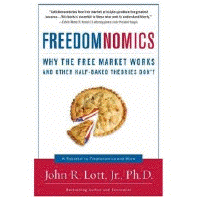
My new book Freedomnomics is hot off the presses and is now starting to find its ways to book stores. It will still be a month before it goes on sale, but I have high hopes for this book. It is quite a relief to see it coming out after all the work that went into it.
Labels: Economics
"Why Economists Tend to Oppose Gun Control Laws"
Useful article:
After the shooting rampage at Virginia Tech, many well-intentioned people all over the country have been calling for increased gun control laws. However, economists tend to oppose gun control laws, since such laws generally pay no attention to basic economic issues.
Let's start with the relationship between means and ends. The shooter had his ends: he wanted to kill many people, and he wanted it to be visible and spectacular. He also had his means: guns and bullets. He engaged in forward-looking behavior: he purchased the guns, bullets, chains, locks, and video equipment well in advance. He taped himself in advance explaining what he was going to do and why he was going to do it.
Now let's consider gun control. Many people argue that if the shooter did not have guns and bullets, he would not have been able to shoot all of those people. This is surely correct. However, from that, they infer that if he did not have guns and bullets, he would not have been able to kill all of those people. This is a whole different question.
As Mises.org readers know, in economics, we discuss the idea of substitutes. These are goods that can be used to replace each other such as Coke vs. Pepsi, contact lenses vs. eyeglasses, Macs vs. PCs. When a person has ends, a person can select among different means to achieve those ends. These different means are substitutes.
Cho wanted to kill many people, and he wanted it to be visible and spectacular. To that end, he purchases guns, bullets, chains, and locks (to prevent survivors from escaping). Would gun control have prevented this? Or would Cho ÷ who apparently planned this attack for weeks, based on the fact that he acquired guns, bullets, chains, and locks for weeks - have used substitute goods?
What would Cho's substitutes have been? What others means are there by which he could engage in mass murder? Well, he could have purchased a knife, although that is probably a weak substitute for guns and bullets in achieving his ends. He has to be right next to his victim, and he might be defeated in personal combat by another person. Likewise, he could not kill a lot of people in the same time frame, and it would not be as spectacular. . . .
Let's start with the relationship between means and ends. The shooter had his ends: he wanted to kill many people, and he wanted it to be visible and spectacular. He also had his means: guns and bullets. He engaged in forward-looking behavior: he purchased the guns, bullets, chains, locks, and video equipment well in advance. He taped himself in advance explaining what he was going to do and why he was going to do it.
Now let's consider gun control. Many people argue that if the shooter did not have guns and bullets, he would not have been able to shoot all of those people. This is surely correct. However, from that, they infer that if he did not have guns and bullets, he would not have been able to kill all of those people. This is a whole different question.
As Mises.org readers know, in economics, we discuss the idea of substitutes. These are goods that can be used to replace each other such as Coke vs. Pepsi, contact lenses vs. eyeglasses, Macs vs. PCs. When a person has ends, a person can select among different means to achieve those ends. These different means are substitutes.
Cho wanted to kill many people, and he wanted it to be visible and spectacular. To that end, he purchases guns, bullets, chains, and locks (to prevent survivors from escaping). Would gun control have prevented this? Or would Cho ÷ who apparently planned this attack for weeks, based on the fact that he acquired guns, bullets, chains, and locks for weeks - have used substitute goods?
What would Cho's substitutes have been? What others means are there by which he could engage in mass murder? Well, he could have purchased a knife, although that is probably a weak substitute for guns and bullets in achieving his ends. He has to be right next to his victim, and he might be defeated in personal combat by another person. Likewise, he could not kill a lot of people in the same time frame, and it would not be as spectacular. . . .
Labels: Economics, GunControl
5/01/2007
Texas Governor Rick Perry: : allow Texans to take their concealed handguns anywhere"
This couldn't be any clearer.
AUSTIN — Gov. Rick Perry, mulling ways to stop the kind of murderous rampages that recently left 33 dead on a college campus in Virginia, said Monday there’s one sure-fire solution he likes: allow Texans to take their concealed handguns anywhere.
Period.
Perry said he opposes any concealed gun-toting restrictions at all — whether it’s in a hospital, a public school, a beer joint or even the local courthouse.
“The last time I checked, putting a sign up that says 'Don’t bring your weapons in here,' someone who has ill intent on their mind — they could care less," Perry told reporters. “I think it makes sense for Texans to be able to protect themselves from deranged individuals, whether they're in church or whether on a college campus or wherever."
As reporters began clicking off a list of places where concealed permit holders face restrictions, Perry cut off the questioning and made it clear that he meant anywhere at all. . . .
Thanks very much to adopted Texan Nick Trout.
Period.
Perry said he opposes any concealed gun-toting restrictions at all — whether it’s in a hospital, a public school, a beer joint or even the local courthouse.
“The last time I checked, putting a sign up that says 'Don’t bring your weapons in here,' someone who has ill intent on their mind — they could care less," Perry told reporters. “I think it makes sense for Texans to be able to protect themselves from deranged individuals, whether they're in church or whether on a college campus or wherever."
As reporters began clicking off a list of places where concealed permit holders face restrictions, Perry cut off the questioning and made it clear that he meant anywhere at all. . . .
Thanks very much to adopted Texan Nick Trout.
Labels: ConcealedCarry
Some Changes in National Presidential Primary Polls
From Rasmussen Reports:
"Former Tennessee Senator Fred Thompson and Arizona Senator John McCain are tied for second at 14%."
Hilary has lost her lead. Obama 32% Clinton 30%
"Former Tennessee Senator Fred Thompson and Arizona Senator John McCain are tied for second at 14%."
Hilary has lost her lead. Obama 32% Clinton 30%
Labels: 2008PresidentialRace, FredThompson