6/25/2014

My newest piece at Fox News: "What the Supreme Court still doesn't understand about guns"

John Lott's latest piece at Fox News starts this way:
In what’s being hailed by many as a victory for gun-control advocates, the recent Supreme Court decision on “straw” purchases of guns has completely muddled the whole issue of background checks and “straw” purchases for potential gun owners.
The court ruled 5-4 that, as The Hill.com put it, “one legal gun owner may not acquire a firearm on behalf of another — a practice known as "straw" purchasing. 
The case heard by the high court involved a Virginia police officer, Bruce Abramski, who bought a gun, a Glock 19 handgun, for his uncle. The police officer, who could get a discount on guns, bought the gun in Virginia. He then transferred it to his uncle, who lived in Pennsylvania, through a second licensed dealer in the state. 
The Obama administration successfully prosecuted Abramski for two felonies. The Justice Department said that the same federal background check form where Abramski indicated that he wasn’t a straw purchaser involved perjury as well as for providing false information to the gun dealer who sold the gun. 
The five Justices who supported Obama’s prosecution, claimed: “That information helps to fight serious crime. When police officers retrieve a gun at a crime scene, they can trace it to the buyer and consider him as a suspect.” 
But there are two big problems with their claim. . . . .
The rest of the piece is continued here.

Labels: ,

4/14/2014

Justice Stevens' op-ed in the Washington Post unintentionally shows the 2nd Amendment wasn't aimed at protecting only government rights

Retired Supreme Court Justice John Paul Stevens has a new book out where he suggests what was originally meant by the 2nd Amendment.  From his op-ed in the Washington Post:
As a result of the rulings in Heller and McDonald, the Second Amendment, which was adopted to protect the states from federal interference with their power to ensure that their militias were “well regulated,” has given federal judges the ultimate power to determine the validity of state regulations of both civilian and militia-related uses of arms. That anomalous result can be avoided by adding five words to the text of the Second Amendment to make it unambiguously conform to the original intent of its draftsmen. As so amended, it would read: 
“A well regulated Militia, being necessary to the security of a free State, the right of the people to keep and bear Arms when serving in the Militia shall not be infringed.” . . .
Stevens would like to add five words and also a comma after the word "Militia."  But Stevens unintentionally shows what those who drafted the amendment would have to have written to make it clear that they wanted it only to apply to those in the militia.  There is a huge difference between "the right of the people to keep and bear Arms shall not be infringed" and "the right of the people to keep and bear Arms when serving in the militia shall not be infringed."  Both statements are quite clear, but while Stevens would like everyone to believe that the 2nd Amendment was written as only a militia right.


Labels: ,

11/21/2013

Justice Breyer on interpreting the Constitution

10/30/2013

Stunning: Retired Supreme Court Justice John Paul Stevens Doesn't Understand Difference between Machine Guns and Semi-automatic guns

This C-SPAN clip shows Justice Paul Stevens explaining that since the Supreme Court recognizes the right of the federal government to ban machine guns, it is possible for the "automatic weapons" used in mass shootings in the US.
Justice Stevens: "the 2nd Amendment provides no obstacle to regulations prohibiting the sort of automatic weapons used in the tragic multiple killings in Virginia, Colorado and Arizona in recent years."
The reference that Stevens is making at the beginning of the clip is to Justice Scalia's opinion in Heller stating:
That would be a startling reading of the opinion, since it would mean that the National Firearms Act’s restrictions on machineguns (not challenged in Miller) might be unconstitutional, machineguns being useful in warfare in 1939. We think that Miller’s “ordinary military equipment” language must be read in tandem with what comes after: “[O]rdinarily when called for [militia] service [able-bodied] men were expected to appear bearing arms supplied by themselves and of the kind in common use at the time.” 307 U. S., at 179. The traditional militia was formed from a pool of men bringing arms “in common use at the time” for lawful purposes like self-defense. . . .  We therefore read Miller to say only that the Second Amendment does not protect those weapons not typically possessed by law-abiding citizens for lawful purposes, such as short-barreled shotguns. . . . 
Obviously, this argument can't be made to semi-automatic weapons such as those used in the very attacks that Justice Stevens discusses for the very reason that semi-automatic weapons are indeed typically possessed by law-abiding citizens for lawful purposes.

How could Stevens write an opinion in the Heller case without him having a clue about the types of weapons that he was writing about?

Labels: ,

6/26/2013

Here is what I think is the key quote from Kennedy's dissent in the California Prop 8 case

From Justice Kennedy's dissent:

The Court’s reasoning does not take into account the fundamental principles or the practical dynamics of the initiative system in California,which uses this mechanism to control and to bypass public officials—the same officials who would not defend theinitiative, an injury the Court now leaves unremedied. The Court’s decision also has implications for the 26 other States that use an initiative or popular referendum system and which, like California, may choose to have initiative proponents stand in for the State when public officials decline to defend an initiative in litigation. . . .
So the US Supreme Court claims that it knows more about how the California laws should be interpreted than a unanimous decision by the California Supreme Court.  But worse, as Justice Kennedy says, if the politicians in office don't like a decision, they can just encourage a lawsuit against the law and then refuse to defend it in court.

Labels: ,

6/25/2013

Bias in The Hill story about Supreme Court decision on Voting Rights Act?

Did the voting rights Act really require a "higher criteria"?  Or was it a political standard?  My guess is that the Obama administration decides to accept decisions for states such as Texas based upon whether it benefits the Democratic Party, not whether it meets some higher moral standard.  The very concern that former Democratic Congressional Campaign Committee Chairman Martin Frost (D-Texas) raises is what motivated Democrat decisions on what redistricting to allow.  From The Hill newspaper:

. . . Barring congressional action, that means a number of states — most of them southern and GOP-controlled — no longer have to meet higher criteria to pass voting laws.  
The ruling holds big implications for congressional redistricting and voter identification laws that Democrats claim are aimed suppressing minority turnout. 
"This makes it much easier for Republicans to draw districts in away that minimizes the opportunities for Democrats in the south, minimizes opportunities for minorities in the South," said former Democratic Congressional Campaign Committee Chairman Martin Frost (D-Texas). . . .

Labels: , ,

How to predict which Supreme Court Justice will write the remaining Supreme Court decisions

My friend John Eastman sent out an interesting email explaining how Supreme Court decides who will write up their decisions.  The short of it is: you look to see who has already written decision for cases based on the month that oral arguments were heard and whatever are left go to the Justices that hadn't yet written a decision on that month's cases. 
. . . 5 cases were decided on Monday, and another 3 today.  That leaves 3 to go, and the Chief Justice announced this morning that they would be released tomorrow at 10:00 a.m. Eastern time.  There is a biggie -- Sekhar v. United Stateswhich considers whether advice from a government lawyer can be considered "property" that can form the basis of an extortion charge.  And there are two cases that have garnered little attention -- United States v. Windsor and Hollingsworth v. Perry.  Oh, wait.  Those are the marriage cases!   
It appears as though Justice Scalia may be writing the opinion in Sekhar, Justice Kennedy the opinion in Windsor (the constitutional challenge to the federal Defense of Marriage Act, DOMA), and the Chief Justice writing in Perry (the constitutional challenge to California's Proposition 8).  This prediction is based on reviewing the authorship of the opinions that have already been released from each sitting of the Court and then lining up the remaining opinions with the Justices who have not yet authored an opinion from that sitting.  For example, the only case argued all the way back in October that had not been released before this week was Fisher v. University of Texas, and the only Justice who had not authored an opinion out of the October sitting was Justice Kennedy.  True to form, Justice Kennedy was the author of that opinion when it was released yesterday -- holding that Texas's race-based affirmative action plan has to be subjected to strict scrutiny by the lower courts and will therefore likely be held to be unconstitutional.  (That, by the way, is not as far as we urged the Court to go in our brief in the case -- we'd like to see the promise of color-blind treatment for all citizens be fully vindicated -- but it is an important step in the right direction!). 
Similarly, Justice Alito was the only Justice without an opinion from the January sitting, and Koontz v. St. Johns River Water Management District (another case in which the CCJ was involved!) was the only undecided case.  This morning, Justice Alito was the author of the majority opinion inKoontz, an important property rights case holding that government cannot condition the issuance of a permit on the relinguishment of property rights that would be unconstitutional "takings" if done directly.  Another win for the good guys, for property rights, and for the Constitution!   
So the only case still undecided from April is Sekhar, and the only Justice without an opinion from that sitting is Justice Scalia.  And the only two cases undecided from March are the two marriage cases, and the Chief Justice and Justice Kennedy are the two justices without an opinion from that sitting. . . .

Labels:

12/13/2012

"Gun Decision Was Product of University of Chicago"

Edward McClelland with NBC Chicago has this claim:
. . . It was a University of Chicago professor, John Lott, who wrote the book "More Guns, Less Crime," which helped build the intellectual argument for conceal carry laws. Lott’s book was published in 1998, the year Chicago surpassed New York as the city with the most murders in the United States.

The 7th Circuit’s opinion was written by Judge Richard Posner, who has been on the faculty of the University of Chicago Law School in 1969. It has been suggested that the U of C faculty’s conservative outlook has a basis in geography: Hyde Park is an embattled island of gentility surrounded by water on one side, and poverty on the other three. It was interesting that Posner’s example of a Chicagoan who needs a gun to protect himself is a resident of Park Tower, a Gold Coast condominium where units run between $1.1 million to $5.7 million. As Posner put it, “a Chicagoan is a good deal more likely to be attacked on a sidewalk in a rough neighborhood than in his apartment on the 35th floor of the Park Tower.” . . .
I don't think that Posner is any particular friend of gun ownership.  One only has to look at his reaction to the Supreme Court's decision after Heller.  For several years while I was a law and economics fellow at the University of Chicago Law School, I lived in faculty apartments at the corner of Singleside Ave and E 60th Street, about a block west of the law school.  At least at the time, if one went a block or so further south, it was not exactly a very safe neighborhood.  One of our family friends was attacked right outside our apartment building.  He was clubbed in the head as he was trying to run away from his attackers and he was suffered severe brain damage.  I can't speak for Dick Posner, but he also lived at the University and anyone living on the South side of Chicago has to be cognizant of the crime problem.
Posner’s opinion was also an attack on federalism -- normally a cherished conservative principle. He argues that since every other state allows conceal carry, Illinois has no grounds for denying it. Is there, in the Constitution, a provision that automatically makes a law apply to every state once a certain number of states have adopted it? . . . .
Does McClelland think that the state of Illinois could ban publication of the Chicago Tribune or Sun-Times?  The 14th Amendment to the Constitution contains what is known as the incorporation clause, which applies the Bill of Rights to the states.  The idea of constitutional protections was that a majority of voters can't deny Americans certain rights.  McClelland doesn't seem to understand that defending constitutional protections is not inconsistent with being conservative.
There is a unique characteristic of criminal activity in Illinois: We have the city with the most murders in the United States. Murders are up over 25 percent this year. We surpassed the 2011 total on Oct. 29. That guns are responsible for this would be evident to anyone with an awareness of the streets of Chicago. But maybe not to someone whose Chicago is confined to the U of C Law Library.
McClelland ignores the ability of people to also use guns to protect themselves.  My research shows that poor blacks who live in high crime areas such as the South side of Chicago are the very people who benefit the most from having guns to protect themselves.

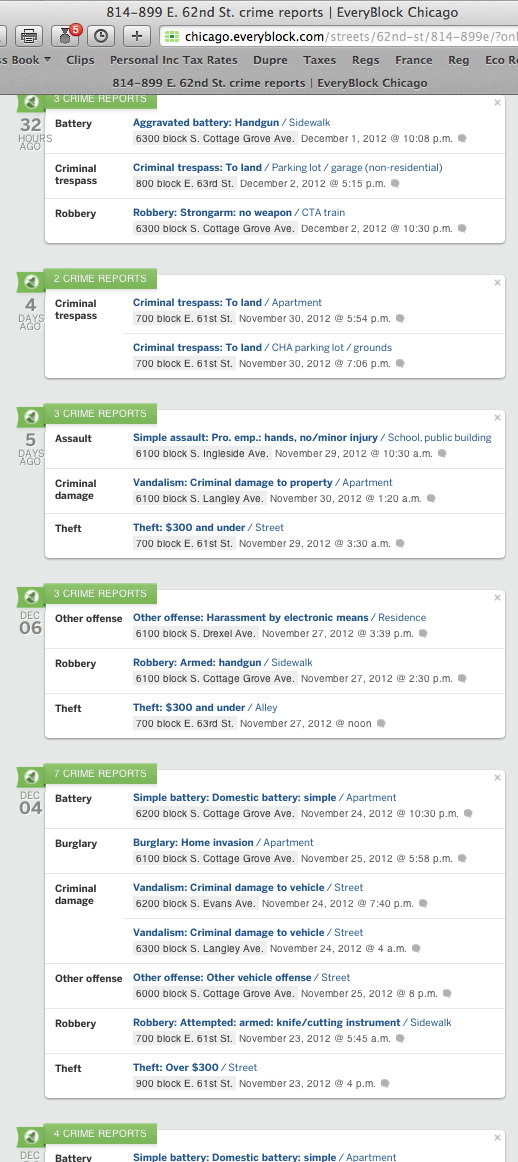
Here are some recent crime reports from an area one block from where we lived.  I would guess that the  University of Chicago has cleaned up the area a little since I lived there.  Click on the picture to make it larger.

Here are the crimes from a block going south down to Drexel.

Labels: , , ,

11/24/2012

Updating the changes in DC's crime rates since Heller

Over the last few years, I have been chronicling how DC murder and violent crime rates have changed before and after the Supreme Court's Heller decision (see here and here).  The Supreme Court's decision came down the end of June 2008, though it took about a month for DC to change its gun laws.  So as to compare the same period of time each year before and after the ban, the following numbers look at the first seven months of each year.

What I have pointed out is that even though very few handgun permits have been issued (only a few thousand the last time that I looked), the big change in DC was the court striking down the ban on having loaded long guns in the District.  It had been a felony to chamber a bullet or a shotgun shell.  When the Supreme Court made its decision over 72,000 adults legally owned long guns.  After the decision, almost a quarter of the adult population were suddenly able to legally use those guns for self defense.

The Boston Globe has this story about the huge recent drop in homicides in DC, but the article fails to note that the drop started right after the Supreme Court decision.  How can one write a story on this without mentioning the court's decision?  The article mentions the crack epidemic.  Crack was indeed a problem, but that problem ended in the early 1990s.

Labels: , , ,

9/30/2012

Supreme Court Justice Ruth Bader Ginsburg was Turned Down by 14 Law Firms

Ruth Bader Ginsburg has this discussion available here.

Labels: ,

9/24/2012

Summary of Arguments in University of Texas at Austin v. Fisher case, the case that could "finally put an end to racial preferences in university admissions"

Mention of recent research that I co-authored on the so-called "critical mass" claim upon which the Supreme Court's decision in Grutter was determined.  In University of Texas at Austin v. Fisher, the Fifth circuit court directly referenced the term "critical mass" 69 times.  The Weekly Standard has a rough summary of the case available here.  The discussion on my work is here:
Fourth, the University of Michigan hornswoggled the Supreme Court in 2003 by insisting that its law school never used numbers or percentages in preferring minorities, but was seeking nothing more than “a critical mass” of minority students. It was a clever and successful dodge. Chief Justice William Rehnquist, in his Grutter dissent, examined the numbers closely and demonstrated, with a clarity that ought to have embarrassed my university, that this position was an outright “sham.” Now in the amicus briefs in Fisher the “critical mass” theory gets a solid drubbing. Twenty-two distinguished scholars of economics and statistics from many universities join in one brief arguing that empirical evidence simply does not demonstrate “that minority students are benefited by a ‘critical mass’ of minorities in the classroom.” Indeed, they conclude, “No reliable empirical evidence known to [these] amici supports the critical mass theory.” 
They go on to present, in a detailed appendix, sets of comparisons of the performance of blacks and whites in classrooms of different sizes with different numbers of each. The “critical mass” theory is statistically demolished. . . .

Labels: , , ,

7/27/2012

Justice Scalia talks gun control

UPDATE: The Hill newspaper has this:
Justice Antonin Scalia said there “are some limitations that can be imposed” on the purchase of guns but would not say whether a legislature could ban semi-automatic weapons or 100-round magazines. “We’ll see,” the Supreme Court justice said Sunday when asked in an interview on Fox News whether a legislature could restrict the purchase of those items in the wake of the movie massacre in Aurora, Colo. Scalia authored the high court’s 2008 opinion in District of Columbia v. Heller, which ruled that the Second Amendment protects an individual right to bear arms and invalidated a D.C. ban on handguns. Scalia noted that as to more specific restrictions on gun purchases, his opinion said those will have to be decided “in future cases.” “Some undoubtedly are [permissible], because there were some that were acknowledged at the time” of the writing of the Constitution, he said on “Fox News Sunday.” “So yes, there are some limitations that can be imposed. What they are will depend on what the society understood were reasonable limitations at the time.” . . .

Labels: , ,

7/01/2012

If John Roberts changed his position on Obamacare to protect the court from being called political, the initial polls are not encouraging

It is possible that the Supreme Court's approval rating would have fallen anyway as the Obama administration and Democrats would have savaged them if they struck down Obamacare, but this can't be encouraging.  From Rasmussen Reports:
Public opinion of the Supreme Court has grown more negative since the highly publicized ruling on the president’s health care law was released. A growing number now believe that the high court is too liberal and that justices pursue their own agenda rather than acting impartially.
week ago,  36% said the court was doing a good or an excellent job. That’s down to 33% today. However, the big change is a rise in negative perceptions. Today, 28% say the Supreme Court is doing a poor job. That’s up 11 points over the past week. . . .
Thirty-seven percent (37%) now believe the Supreme Court is too liberal, while 22% think it's too conservative. A week ago, public opinion was much more evenly divided:  32% said it was too liberal and 25% said too conservative. . . .
Jan Crawford at CBS is someone who I have met and I think that she comes across as quite credible.  She claims to have two well placed sources who say that Roberts changed his position as a result of outside pressure on the court.
Chief Justice John Roberts initially sided with the Supreme Court's four conservative justices to strike down the heart of President Obama's health care reform law, the Affordable Care Act, but later changed his position and formed an alliance with liberals to uphold the bulk of the law, according to two sources with specific knowledge of the deliberations.
Roberts then withstood a month-long, desperate campaign to bring him back to his original position, the sources said. Ironically, Justice Anthony Kennedy - believed by many conservatives to be the justice most likely to defect and vote for the law - led the effort to try to bring Roberts back to the fold.
"He was relentless," one source said of Kennedy's efforts. "He was very engaged in this."
But this time, Roberts held firm. And so the conservatives handed him their own message which, as one justice put it, essentially translated into, "You're on your own." . . .
Some of the conservatives, such as Justice Clarence Thomas, deliberately avoid news articles on the Court when issues are pending (and avoid some publications altogether, such as The New York Times). They've explained that they don't want to be influenced by outside opinion or feel pressure from outlets that are perceived as liberal.
But Roberts pays attention to media coverage. As Chief Justice, he is keenly aware of his leadership role on the Court, and he also is sensitive to how the Court is perceived by the public.
There were countless news articles in May warning of damage to the Court - and to Roberts' reputation - if the Court were to strike down the mandate. Leading politicians, including the President himself, had expressed confidence the mandate would be upheld. . . . .
The funny thing is that while the liberals on the court talk about giving respect to legislative decisions, it is clear that they only give respect to decisions by liberal legislatures.  For example, the court just recently struck down a decision to give life sentences without parole to juveniles who commit especially heinous acts of murder.  The court had previously struck down the death penalty for 17 year olds, and states moved to have life in prison. Now that has been struck down.  

Labels: , , ,

6/28/2012

How come only conservatives get blamed for dysfunctional government?


David Gregory: "What happens if it is struck down in part or in whole by a 5 to 4 decision? Would that not underscore how dysfunctional our government is, the major institutions of our government are? That is a real nightmare scenario, I think, for the political class in this country." 
Why isn't it dysfunctional if the Supreme Court only approved it by a 5-4 margin? 
"Chief Justice Roberts....he has spoken publicly about how on big controversial decisions, he thinks a 5-4 majority on the Court overtime undermines the Supreme Court. And only fuels the view that our major political institutions are too polarized. He's taken a big step here. He's going to be cheered for that by some on the Right and the Left, criticized I'm sure, as well, by some on Right."
So does this mean that the four liberal justices who voted in a block are the polarizers? 

Labels: , ,

6/24/2012

So if the individual mandate in Obamacare is struck down, what is the probability that all of Obamacare will be struck down

A survey of former Supreme Court clerks and 18 attorneys who have argued before the court gives us some information.


So the bottom line? They think that the mandate will be found unconstitutional. But the various other questions indicate that only part of Obamacare will be struck down.  That the Medicaid expansion will be upheld (essentially meaning that there is no limit to what can be required in exchange for government funds) and that even if that is struck down, it won't cause anything else to be struck down.    

The House originally had a severability clause in Obamacare.  The Senate took this out, but because of Scott Brown winning in Massachusetts the House couldn't put the clause back in.  So how is the court going to logically decide what to keep and what not to keep?  Here are two telling comments:

JUSTICE SCALIA: Mr. Kneedler, what happened to the Eighth Amendment? You really want us to go through these 2,700 pages?
And this even more telling discussion.
JUSTICE BREYER: I don't think it's not uncommon that Congress passes an act, and then there are many titles, and some of the titles have nothing to do with the other titles. That's a common thing. And you're saying you've never found an instance where they are all struck out when they have nothing to do with each other. My question is, because I hear Mr. Clement saying something not too different from what you say.  He talks about things at the periphery. We can't reject or accept an argument on severability because it's a lot of work for us. That's beside the point. But do you think that it's possible for you and Mr. Clement, on exploring this, to — to get together and agree on -­ (Laughter) JUSTICE BREYER: — I mean on — on a list of things that are in both your opinions peripheral, then you would focus on those areas where one of you thinks it's peripheral and one of you thinks it's not peripheral. And at that point it might turn out to be far fewer than we are currently imagining. At which point we could hold an argument or figure out some way or somebody hold an argument and try to — try to get those done. Is -- is this a pipe dream or is that a - 
MR. KNEEDLER: I — I — I just don't think that is realistic. The Court would be doing it without the parties, the millions of parties -­ 
JUSTICE SCALIA: You can have a conference committee report afterwards, maybe. (Laughter)  
MR. KNEEDLER: No, it just — it just is not something that a court would ordinarily do. But I would like -­  
The sad thing is that Breyer wants to desperately save the rest of the law and this was the best that he could come up with.  With comments such as these, how is it possible that they can pick and choose what parts of the law to keep?

UPDATE: Is it possible for the New York Times to write a news story that isn't very biased?
Congress held no hearing on the plan’s constitutionality until nearly a year after it was signed into law. Representative Nancy Pelosi, then the House speaker, scoffed when a reporter asked what part of the Constitution empowered Congress to force Americans to buy health insurance. “Are you serious?” she asked with disdain. “Are you serious?”
Opponents of the health plan were indeed serious, and so was the Supreme Court, which devoted more time to hearing the case than to any other in decades. A White House that had assumed any challenge would fail now fears that a centerpiece of Mr. Obama’s presidency may be partly or completely overturned on a theory that it gave little credence. The miscalculation left the administration on the defensive as its legal strategy evolved over the last two years.
“It led to some people taking it too lightly,” said a Congressional lawyer who like others involved in drafting the law declined to be identified before the ruling. “It shouldn’t strike anybody as a close call,” the lawyer added, but “given where we are now, do I wish we had focused even more on this? I guess I would say yes.”
Looking back, Democrats said they had had every reason for confidence, given decades of Supreme Court precedents affirming Congress’s authority to regulate interstate commerce, and lawyers who defended the law said they had always taken the challenge seriously even if politicians had not. But they underestimated the chances that conservative judges might, in this view, radically reinterpret or discard those precedents. . . .
Does this article strike one as being written for and by Democrats?  It is true that for decades the Supreme Court had obliterated the original meaning of the commerce Clause, but does that mean that the congress can stretch that meaning even more?  Surely even Democrats must see a difference between a farmer who grows wheat for his own consumption being regulated and forcing someone to grow wheat (or in this case forcing them to buy health insurance).  Why is acknowledging such a difference the same as radically reinterpreting or discarding precedents?  Of course, the piece has other references to an "increasingly activist court."

One has to really appreciate how the New York Times keeps on blaming the poor presentation by Verrilli, as if the Justices aren't able to evaluate the arguments independently of how well the lawyers before them argue their cases.
By the end of January 2011, judges in Florida and Virginia had ruled it unconstitutional. Only then did the Senate and the House hold hearings on its constitutionality, and the administration grew worried. . . . Donald B. Verrilli Jr., who became solicitor general last June, rehearsed in multiple moot court sessions. But on the critical day of Supreme Court arguments on March 27, he momentarily choked on a drink of water and was hammered by justices skeptical of his argument. He gave a rambling answer about the limits of Congressional power and had a hard time controlling the discussion as he was peppered with questions. . .
Why not just accept that Verrilli had an almost impossible case to make? 

Labels: ,

6/18/2012

The false claims about Scalia's inconsistencies

TPM and other Democrat liberal organizations are launching last ditch efforts to save Obamacare.  Among their targets is: Supreme Court Justice Scalia.  In his new book, Scalia questions whether the infamous 1942 Wickard v. Filburn decision was correctly decided.  They have argued that Scalia is a political opportunist.  
“This is typical Scalia,” added Adam Winkler, a professor at UCLA School of Law. “He respects precedents when they fit his conservative ideology and disregards them when they don’t. … “Once again, we see that Scalia’s originalism is a charade.” . . .
I have my own issues with Mr. Winkler, but I don't see any back and forth on this issue.  People normally go from Lopez to Gonzales v. Raich, but those two cases aren't inconsistent.  Lopez was much less novel that people claim since all the congress had to do was repass the same law with a very minor change that just required that prosecutors had to make a finding that interstate trade was impacted.  That had long been the standard, but Schumer had forgotten to put the language in the safe school zone bill.  So based on his book there is one change, and there are logical reasons for why he would make that change now.  Wickard had been difficult to maintain because overturning it would eliminate huge sections of the Federal government.  But now, with Obamacare, those costs to the court of overturning so much precedent is balanced against new pushes for whole new areas of regulation.

Labels: ,

6/07/2012

Could the Supreme Court save a $1 trillion at a stroke?

Remember all the promises about the 2010 health care law being budget neutral? Now people are talking about how much the Supreme Court decision to strike down the health care law could save a lot of money. From Politico:
Congress could stumble into a big pile of cash from an unlikely source: the Supreme Court. The justices will deliver their landmark ruling on the 2010 health care law this month, and the government is in line to reap hundreds of billions of dollars in savings — perhaps more than $1 trillion — if certain parts of it are struck down. That money could be freed up just in time for a battle over whether automatic cuts to the Pentagon and social programs will kick in, and some members of Congress are already dreaming about the possibilities. “We’re thinking [about] different options, but there are so many variations of what could happen from the court decision, it’s hard to make any hard plans,” said House Appropriations Committee Chairman Hal Rogers (R-Ky.). But, he added, a windfall “would be a factor” in discussions about whether to keep in place pending Pentagon cuts. . . .

Labels: ,

5/12/2012

Can vulnerable Democrat Senators really separate themselves from Obama on gay marriage?

According to The Hill newspaper, many Democratic Senators in swing states are distancing themselves from Obama on gay marriage.  But here is the problem.  This issue is going to be decided by the Supreme Court.  Does anyone doubt that Obama won't appoint another very liberal member of the court who would rule that there is "no rational basis" for ruling that marriage must be between a man and a woman?

Labels: , ,

4/01/2012

Paul Krugman's embarrassingly weak analysis on the Supreme Court debate over health care

Krugman's piece on Friday, "Broccoli and Bad Faith," continues his trend for polemics over accuracy or analysis.
Let's start with the already famous exchange in which Justice Antonin Scalia compared the purchase of health insurance to the purchase of broccoli, with the implication that if the government can compel you to do the former, it can also compel you to do the latter. That comparison horrified health care experts all across America because health insurance is nothing like broccoli. Why? When people choose not to buy broccoli, they don't make broccoli unavailable to those who want it. But when people don't buy health insurance until they get sick -- which is what happens in the absence of a mandate -- the resulting worsening of the risk pool makes insurance more expensive, and often unaffordable, for those who remain. As a result, unregulated health insurance basically doesn't work, and never has. . . .
OK, so if you wait until you are sick before you buy health insurance, you drive up the price of insurance for others. But the exact same argument exists for broccoli. If broccoli makes you healthier and you don't eat it, you are more likely to get sick and you will shift up the demand curve for health care, raising the price of insurance.
unregulated health insurance basically doesn't work, and never has. . . .
Krugman is well-known for his assertions. If you got rid of insurance regulations, prices would be set according to risk.
I was struck, in particular, by the argument over whether requiring that state governments participate in an expansion of Medicaid -- an expansion, by the way, for which they would foot only a small fraction of the bill -- constituted unacceptable "coercion." One would have thought that this claim was self-evidently absurd. After all, states are free to opt out of Medicaid if they choose; Medicaid's "coercive" power comes only from the fact that the federal government provides aid to states that are willing to follow the program's guidelines. If you offer to give me a lot of money, but only if I perform certain tasks, is that servitude? . . .
The discussion before the Supreme Court was over "coercion," not "servitude." "Coercion" means to impose a cost on others. As any economist knows, costs are always opportunity costs. Giving up money represents an opportunity cost. But let me make it simple for Krugman: You take money from me by force and give it back only if I do want what you want me to do. That sure seems like coercion.

Labels: , , ,

3/30/2012

The Vote on Severability on Obamacare

My guess is that the vote on striking down the entire Obamacare bill could be 6 to 2 or even higher.  If anything this is the one of the four decisions that could be great that 5 to 4.  Why?  Kagan and Sotomayer asked about whether the simplest rule for striking down an entire bill is whether the congress didn't include a sever ability clause.  Then there is this discussion by Breyer and Scalia.  The bill just seems to long to make figure out what to include or exclude to difficult for anyone to determine. From CNS news:


“Could I ask you one question, which is a practical question,” Breyer asked of Paul Clement, the lawyer representing the state of Florida in the case.
“I take as a given your answer to Justice Kennedy,’ said Breyer, “you are saying let's look at it objectively and say what Congress has intended, okay? This is the mandate in the community, this is Titles I and II, the mandate, the community, pre-existing condition, okay? Here's the rest of it, you know.
“And when I look through the rest of it, I have all kinds of stuff in there,” said Breyer. “And I haven't read every word of that, I promise.
“As you pointed out, there is biosimilarity, there is breast feeding, there is promoting nurses and doctors to serve underserved areas, there is the CLASS Act, etcetera,” said Breyer.
“What do you suggest we do?” said Breyer. “I mean, should we appoint a special master with an instruction? Should we go back to the district court? You haven't argued most of these. As I hear you now, you're pretty close to the SG [the Obama administration’s solicitor general]. I mean, you'd like it all struck down, but we are supposed to apply the objective test. I don't know if you differ very much.
“So what do you propose that we do other than spend a year reading all this and have you argument all this?” said Breyer.
Also on Wednesday, Justice Antonin Scalia jokingly invoked the Eighth Amendment—which prohibits cruel and unusual punishments—when discussing the “severability” issue with Deputy Solicitor General Ed Kneedler. Scalia’s remarks elicited laughter from the audience in the court chamber.
“Mr. Kneedler, what happened to the Eighth Amendment? You really want us to go through these 2,700 pages?” said Scalia.
“And do you really expect the Court to do that? Or do you expect us to give this function to our law clerks?” said Scalia.
“Is this not totally unrealistic? That we're going to go through this enormous bill item by item and decide each one?” he said. . . .

Here is a prediction using some work by Landes and Posner that the individual mandate will be struck down.
The statistics illustrate the stark divide on the court -- the four Democratic appointees, Justices Elena KaganStephen G. BreyerSonia Sotomayor and Ruth Bader Ginsburg -- all aimed their comments at Clement and Carvin by a heavy margin. Three of the five Republican appointees, Chief Justice John G. Roberts Jr. and Justices Samuel Alito and Antonin Scalia, were equally one-sided, aiming the overwhelming majority of their comments at Verrilli.
Kennedy was somewhat less skewed, but was far closer to the conservative side, with comments to Verrilli outnumbering those to Clement and Carvin by a 2-1 margin.
The statistics also support another observation court watchers have made -- Breyer is by far the wordiest justice. 

Labels: ,