9/05/2011

So why does a bigger fork make one eat less?

Assuming that this claim is true? Why?

In a recent study done at an Italian restaurant, researchers found that diners who used larger utensils ate less, surprisingly enough. The researchers believe that bigger forks somehow trick people's minds into thinking they've eaten more. . . .


Another possibility is that eating a meal with a big fork is awkward and more difficult. Could it simply be that if you make eating more difficult, people will eat less? I did see some research years ago that babies who were breastfeed consumed less milk during any given meal than those feed from a bottle. The reason was that more work was required by the baby. One interesting consequence of this is that breastfeed babies are thus more likely to wake up during the night wanting to eat more. It seems hard to think that breastfeed babies are having some "mind tricks" occurring to them.

Just as the size of our houses have doubled over the last 30 years, so apparently also have the sizes of our meals (though the meal sizes have grown more slowly).
Meal sizes have grown over the past few decades, contributing to an obesity epidemic in the United States. In fact, Cornell University researchers recently found amusing proof of portion swelling when they compared the 1936 and the 2006 editions of that homemaking classic, Joy of Cooking. They found that the recipe for chicken gumbo went from 228 calories per serving in the 1936 version to 576 calories in the 2006 edition. Why? The editors simply had to jack up the portion sizes to meet our oversized modern-day appetites. . . .

Labels: ,

8/21/2011

Obama Administration rejects trial experiment in NYC that would have temporarily stopped using Food Stamps on SweetenedSodas

There is a problem: the poor on food stamps are obese.

There is, on the other hand, a lot of evidence of obesity among the poor; their obesity rate is estimated at 36%, and the obesity rate among poor children seems to be about twice the rate among non-poor children. The poor people are eating more calories than they need. . . .


Apparently, there is some research claiming that soda and potato chips are the two worst foods for your weight.

So why not say if the government is going to pay for your food, we will restrict what you can buy. You are not allowed to use food stamps to buy alcohol, so why not some other types of drinks that are deemed wasteful?

Well, NYC tried, but the Obama administration said no. Possibly, they just don't want to discourage people from going on food stamps.

While sharing the goal of reducing obesity, an official with the nation's food stamp program said in a letter Friday addressed to the state Office of Temporary and Disability Assistance that the USDA had concerns about the plan's "potential viability and effectiveness."

Jessica Shahin, associate administrator of the program, wrote that the proposal lacked clear product eligibility guidelines, didn't take into account the burden that might be placed on city food retailers and failed to put forward a credible design for evaluating the effect on obesity and health. . . .


A "burden that might be placed on city food retailers"? How is that possible? If consumers change what they want to buy for any reason, why wouldn't food stores start stocking the new products that they want to buy?

Here is the weird thing. The Obama administration has no problems restricting what Americans in general eat, but that they don't want to restrict what those who the get their food costs paid by the government eat. Examples:

1) Salt:
The FDA, acting on a recommendation to be made by a task force of the Institute of Medicine of the National Academy of Sciences, is about to take the unprecedented step of regulating the salt content of processed foods. . . .


2) the FDA's New Calorie Count Regulations

Labels: , ,

11/19/2010

The cost of food safety regulations

This discussion at RedState has some discussion of the costs. The government costs are here:

The Congressional Budget Office has calculated that this overreaching bill would cost $1.4 billion between 2011 and 2015. To carry out these new rules, the federal government will hire over 17,000 new bureaucrats. Food producers will likely spend hundreds of millions of dollars annually complying with these unnecessary government regulations. This cost will be passed onto consumers in the form of higher food prices. Big agriculture is one of the largest proponents of the bill since it will likely destroy their competitors who cannot afford the high cost of these regulations. . . .

Labels: ,

4/28/2010

Most Americans oppose letting government regulate salt intake

From Rasmussen reports:

The latest Rasmussen Reports national telephone survey shows that just 33% of Americans think the government should set limits on how much salt Americans can eat. Most adults (55%) disagree and don't think it's any of the FDA's business. Another 12% are not sure.
Perhaps one reason why Americans don’t see a need for government regulation of their salt intake is that 77% of adults say they already monitor the ingredients in their food at least somewhat closely on their own. Only 21% of Americans say they do not closely check what’s in their food. Those numbers include 31% who say they monitor their food very closely and only six percent (6%) who don’t watch what they eat at all.
Still, most Americans (54%) hold a favorable opinion of the FDA, while 39% view it unfavorably. Those results have changed little since a survey conducted three years ago. . . .

Labels: ,

5/01/2008

Politicians seek to control what people eat

New Jersey considers taxing fast foods:

Now some lawmakers in New Jersey are considering taking food taxes a step further and install a proverbial "sin" tax on fast food.

Yes, the idea of marking up your favorite fast food burger or pack of fries is actually being tossed around, and it's not settling well with many residents.

"They're taxing everything. Now you're gonna tax fast food? That's crazy," said Newark resident Miriam Robertson.

Added Livingston resident Tina Abrahamian: "No one wants to be taxed. I mean, it's a necessity to eat and people need to eat and with everything skyrocketing, that's the last thing we want to tax." . . .

A spokesperson for the governor, however, told CBS 2 on Wednesday:

"The governor is open to reasonable solutions to help solve our financing problems, but there are no plans for any fast food tax."

Labels: ,

4/28/2008

New Op-ed up at Fox News: Ethanol Mandates Cause Rising Food Prices

You can read the new piece here:

Food prices are rising worldwide. Some nations, such as Egypt and Cameroon, are facing riots as the prices for basic food stuffs rise. Other countries from India to Cambodia have banned food exports to try and keep prices low and reduce voter anger.

In the U.S., the Wall Street Journal last week gave advice normally associated with survivalists warning about the end of civilization. Readers were warned to start hoarding non-perishables ("Dried pasta, rice, cereals, and cans of everything from tuna fish to fruit and vegetables").

But in case anyone missed the seriousness of the message, the Journal went so far as to give the extra advice that: "You should also save money by buying them in bulk."

Not all food prices are soaring, however. Food and beverages as a group aren’t rising much faster than overall inflation. Inflation over the last year was slightly under 4 percent, with food and beverages at 4.4 percent. . . .


UPDATE: IBD notes that "The International Monetary Fund says U.S. ethanol production accounts for half the rise in global corn demand since 2005."

Labels: , , , , ,

Anti-aging foods

Foods that help delay the aging process are discussed here.

Red grapes- red grape juice, red wine
tomatoes - cooked tomatoes
almonds
Whole grains
olive oil, as your cooking oil

Labels:

4/19/2008

Yet more regulations on restaurants in New York City

The bottom line is that if the customers really wanted this information, restaurants would provide it:

NEW YORK - New York City health officials won a big victory Wednesday when a federal judge upheld a regulation requiring some chain restaurants to post calories on menus and menu boards.

U.S. District Judge Richard Holwell rebuffed a challenge from the New York State Restaurant Association, an industry trade group that argued that the rule violates the First Amendment by forcing restaurants to "convey the government's message regarding the importance of calories."

The Department of Health and Mental Hygiene believes the regulation, which takes effect Monday, will help the city achieve its goal of reducing obesity. The judge agreed.

"It seems reasonable to expect that some consumers will use the information disclosed ... to select lower calorie meals ... and these choices will lead to a lower incidence of obesity," Holwell said. . . . .

Labels: ,

6/03/2007

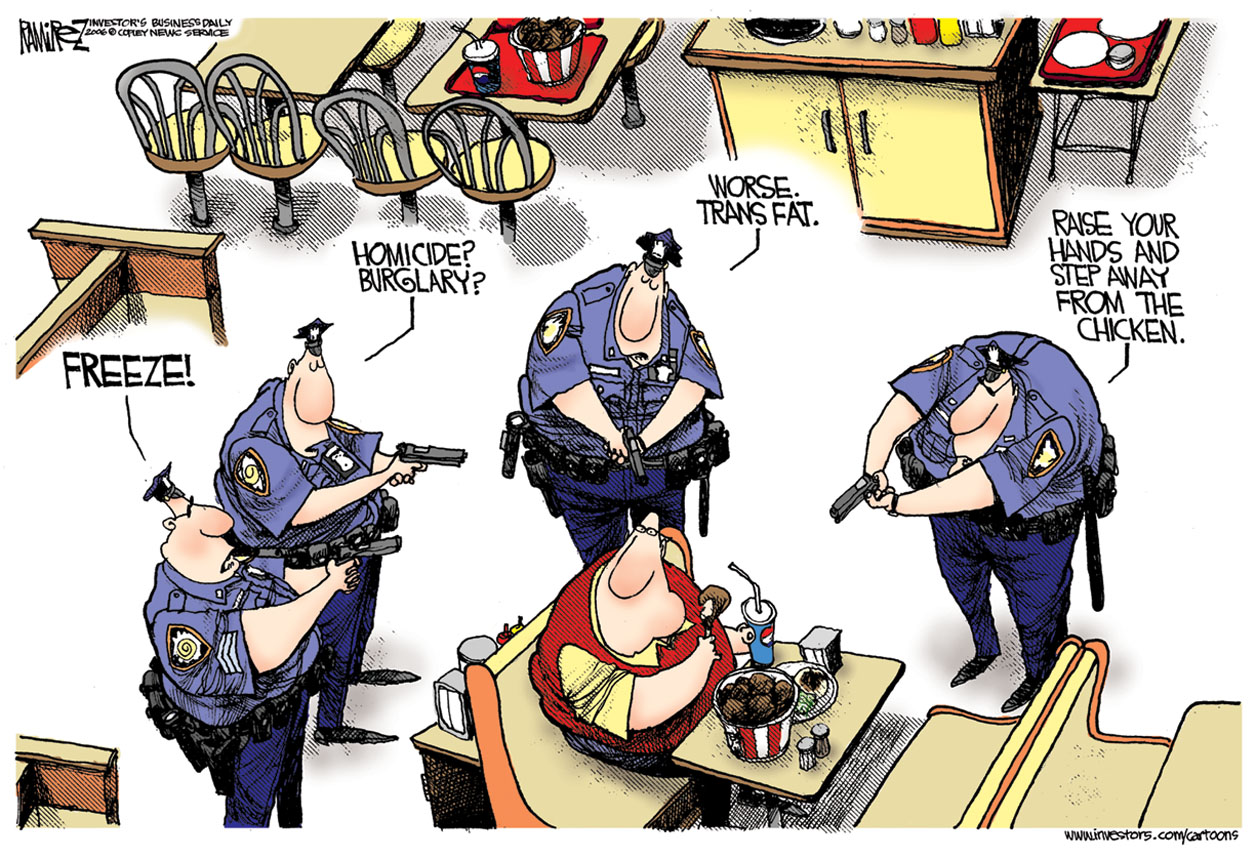
At least this will keep the police busy

Labels: ,